
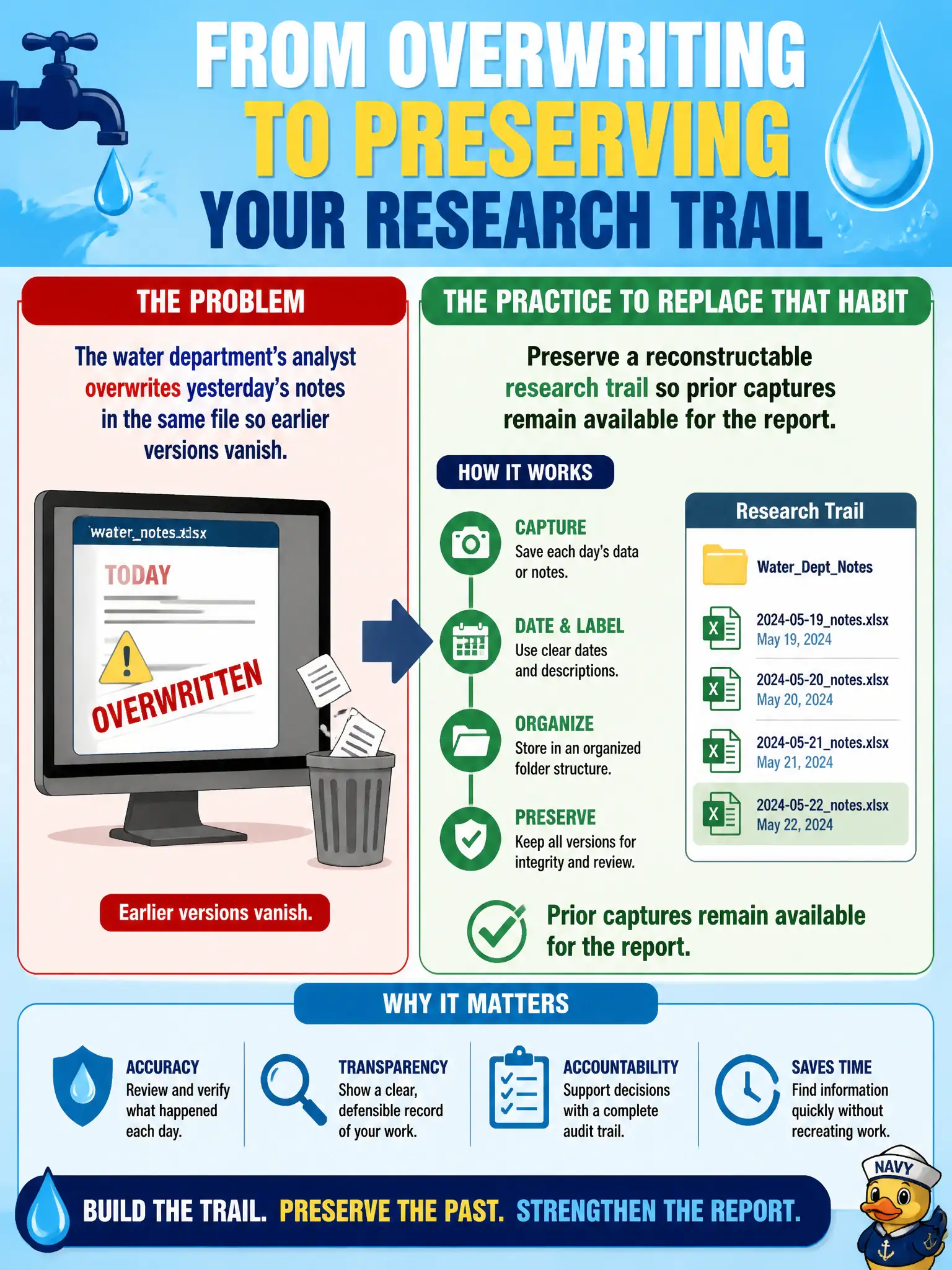
The water department's analyst overwrites yesterday's notes in the same file so earlier versions vanish. What practice should replace that habit?
Select an answer to reveal the explanation.
Short Explanation
Scratching out yesterday's lab notes does not make today's experiment cleaner. If the old capture is gone, nobody can show how the finding grew. Keep versions so the trail can be walked backward.
Full Explanation
A reconstructable research trail requires preserving prior captures so earlier observations remain available when the water department report is drafted or challenged. Overwriting yesterday's notes in the same file until earlier versions vanish destroys chronology and makes it impossible to show what was known when. Overwriting daily so the working file never grows prioritizes file size over auditability. Emailing the file to a personal account and then deleting the official copy creates a retention and OPSEC failure rather than a version history. Keeping only the latest sentence while discarding the sources that led to it leaves conclusions without exhibits. Exam caveat: working drafts may be condensed, but source captures and dated notes should be archived, not erased, when content changes. Operational check: use dated note entries or versioned files so a reviewer can still open yesterday's locator list after today's rewrite. Keep the civic purpose, method limits, and exhibit labels aligned so reviewers can see what was public-source work versus other authorities. Document residual uncertainty explicitly rather than implying completeness. Prefer reversible public methods and preserve exhibits that a second analyst can reopen without guessing.