
Permitting staff screenshot a vendor site but crop out the address bar. Why is that a problem for OSINT evidence?
Select an answer to reveal the explanation.
Short Explanation
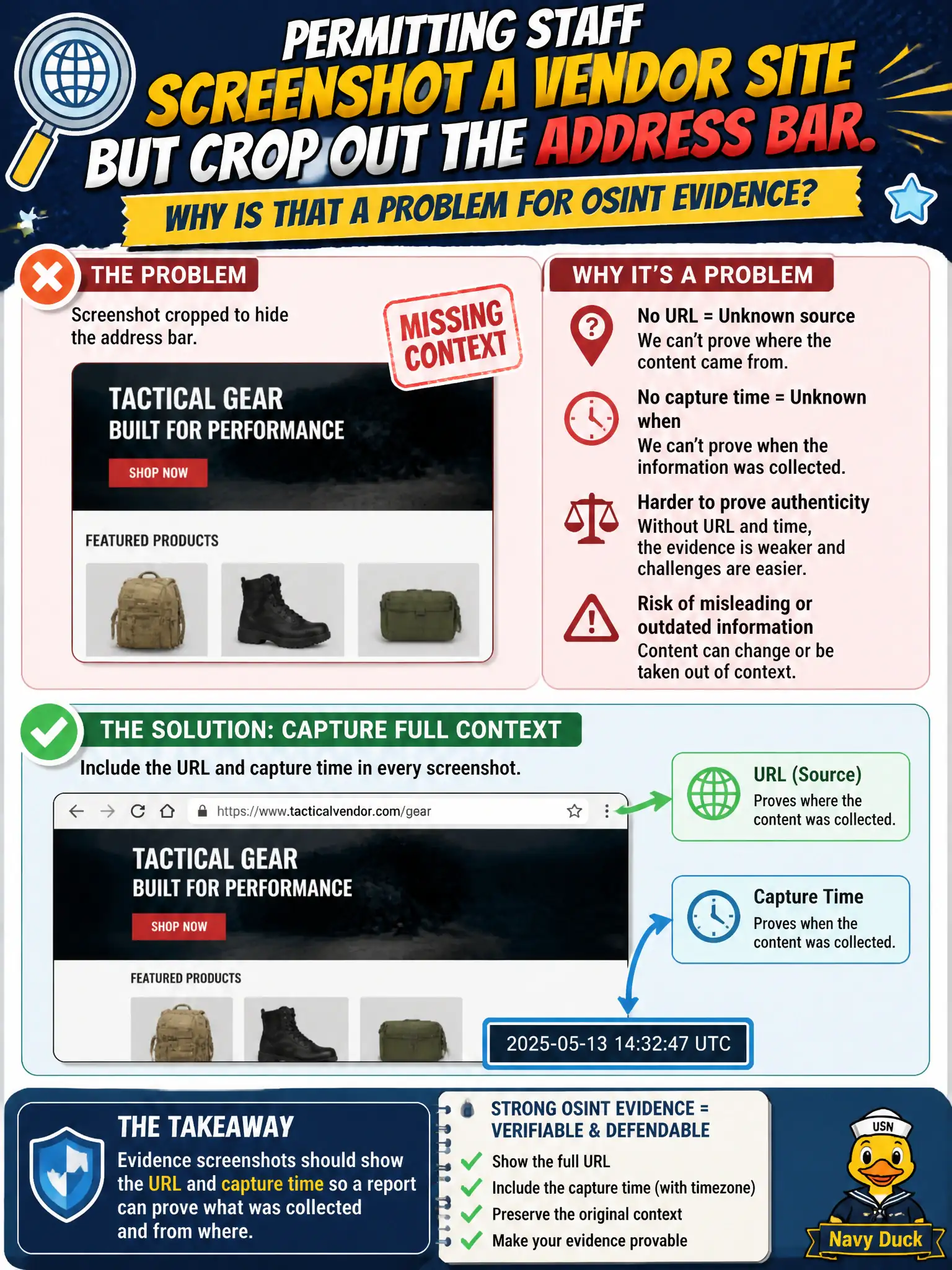
A photo of a storefront with the street sign cropped off cannot prove which shop it was. The address bar and a timestamp are the sign on the building. Without them, the screenshot is just a picture, not evidence.
Full Explanation
Evidence screenshots for OSINT should preserve the URL (address bar or equivalent locator) and capture time so a permitting report can prove what was collected and from where. Cropping out the address bar breaks that chain and leaves a floating image that is hard to authenticate later. Preferring cropped shots because they load faster in email optimizes for convenience over evidentiary value. Treating the address bar as decorative noise to remove for a clean exhibit misunderstands what makes a web capture useful in civic work. Keeping only the vendor logo without the locator likewise fails to show the collected page. Exam caveat: when UI chrome must be redacted for privacy, still retain a recorded URL and timestamp in the accompanying note even if the visible chrome is masked in a public-facing appendix. Operational check: reject any exhibit screenshot that lacks a visible or separately logged locator and capture time before it enters the vendor packet. Keep the civic purpose, method limits, and exhibit labels aligned so reviewers can see what was public-source work versus other authorities. Document residual uncertainty explicitly rather than implying completeness. Prefer reversible public methods and preserve exhibits that a second analyst can reopen without guessing.