
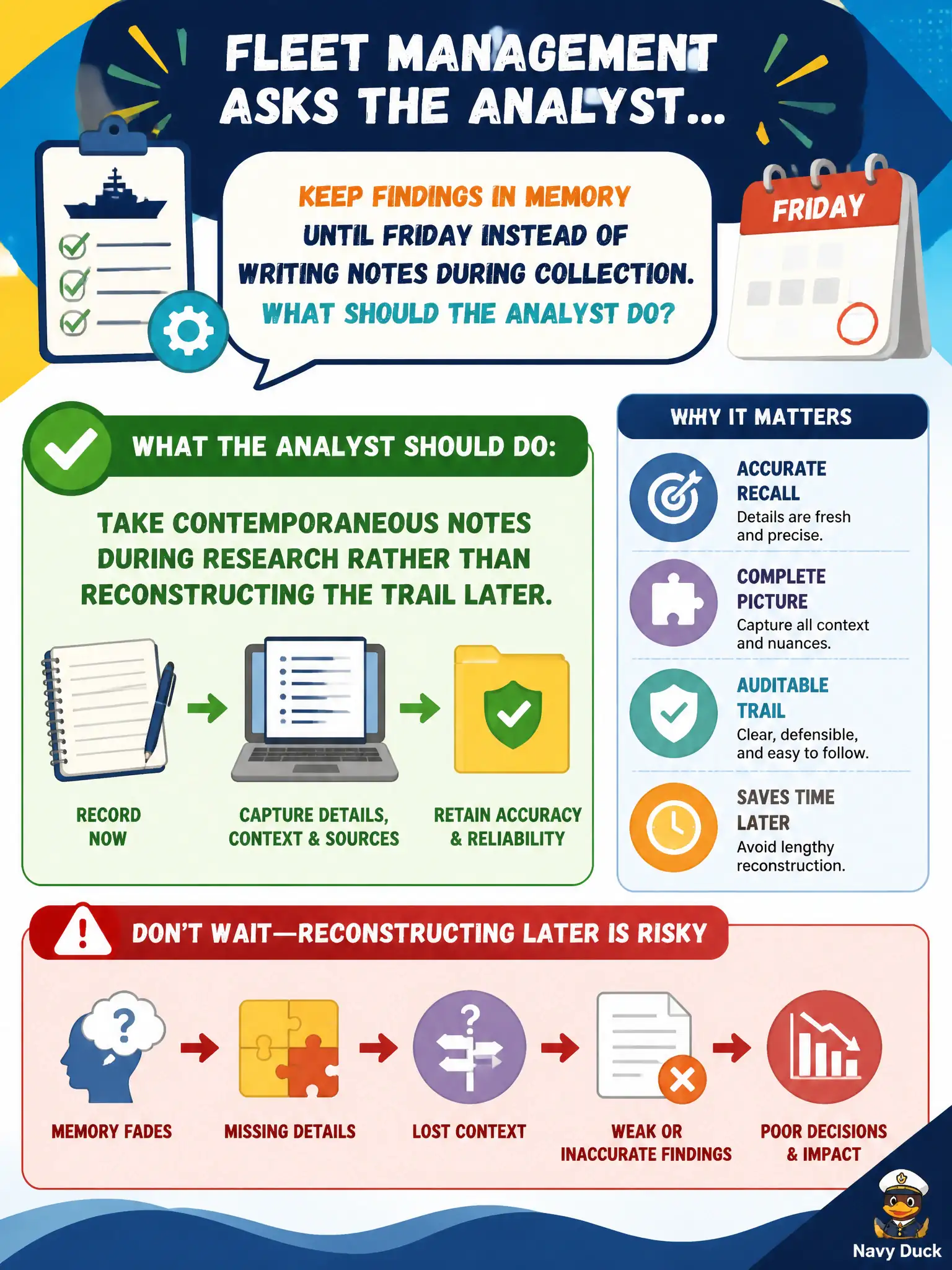
Fleet management asks the analyst to keep findings in memory until Friday instead of writing notes during collection. What should the analyst do?
Select an answer to reveal the explanation.
Short Explanation
A cook who waits until dessert to write the recipe will forget the salt. Time-boxed OSINT works the same way. Notes get taken while the page is open, not rebuilt from memory on Friday.
Full Explanation
Contemporaneous notes during research are required because open-web trails are easy to forget and hard to reconstruct accurately days later. Fleet management asking the analyst to keep findings only in memory until Friday invites missing URLs, swapped dates, and invented details. Waiting until Friday to write from memory so the file stays clean trades neatness for integrity. Recording nothing until a supervisor asks for a briefing leaves no trail if priorities shift midweek. Storing findings only as browser history and hoping the cache survives until Friday depends on volatile client state that clearing, sync, or device change can erase. Exam caveat: polished prose can wait for the report draft, but raw locators and timestamps should be captured in the moment of observation. Operational check: for each useful page, write URL, retrieved-on time, and a one-line observation before navigating away; do not rely on recall or browser history as the notebook. Keep the civic purpose, method limits, and exhibit labels aligned so reviewers can see what was public-source work versus other authorities. Document residual uncertainty explicitly rather than implying completeness. Prefer reversible public methods and preserve exhibits that a second analyst can reopen without guessing.