
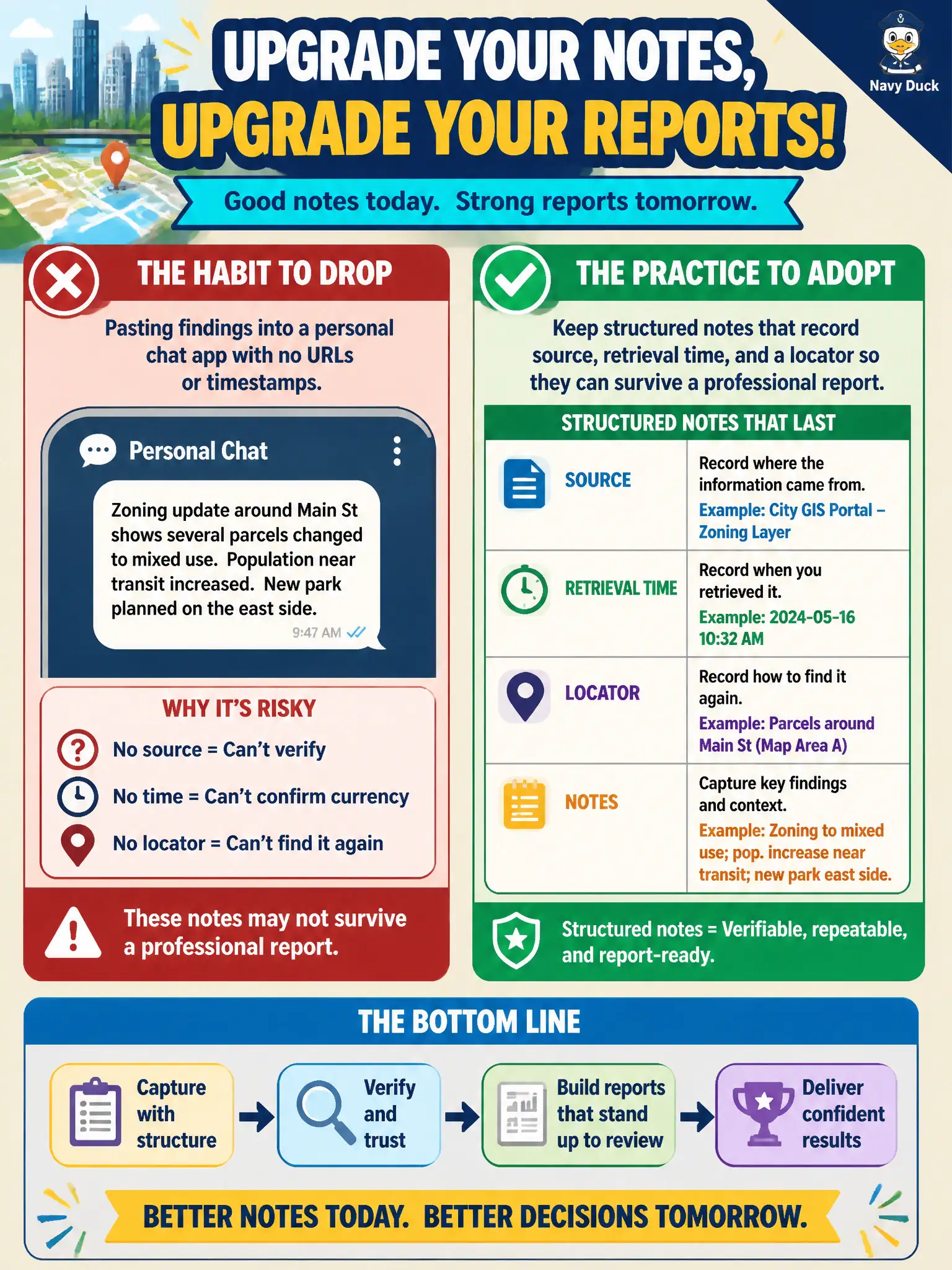
A city GIS analyst pastes findings into a personal chat app with no URLs or timestamps. What note practice should replace that habit?
Select an answer to reveal the explanation.
Short Explanation
Sticky notes on a fridge vanish; a logbook does not. Chat snippets with no URL and no time cannot be rebuilt in a report. Capture source, when it was pulled, and where it lived.
Full Explanation
Professional OSINT notes must survive conversion into a report: each material finding needs a source description, retrieval time, and a locator such as a URL. Pasting findings into a personal chat app with no URLs or timestamps creates ephemeral, unauditable debris that another analyst cannot reopen. Adding a thumbs-up when something looks important does not supply provenance. Memorizing the best links and typing them from memory on Friday invites error and loss. Deleting chat history after each session to look like stronger OPSEC destroys the research trail that quality review requires. Exam caveat: chat tools can be used as temporary scratch space only if durable notes are transcribed promptly into the official notebook with full locators. Operational check: before ending a research block, transfer every claim that might enter the report into a structured note with URL, timestamp, and one-line relevance, then treat the chat thread as disposable scratch—not the case file. Keep the civic purpose, method limits, and exhibit labels aligned so reviewers can see what was public-source work versus other authorities. Document residual uncertainty explicitly rather than implying completeness.