
The elections office wants campaign-finance PDFs from the state disclosure site used in a vendor conflict check. How should those files be treated?
Select an answer to reveal the explanation.
Short Explanation
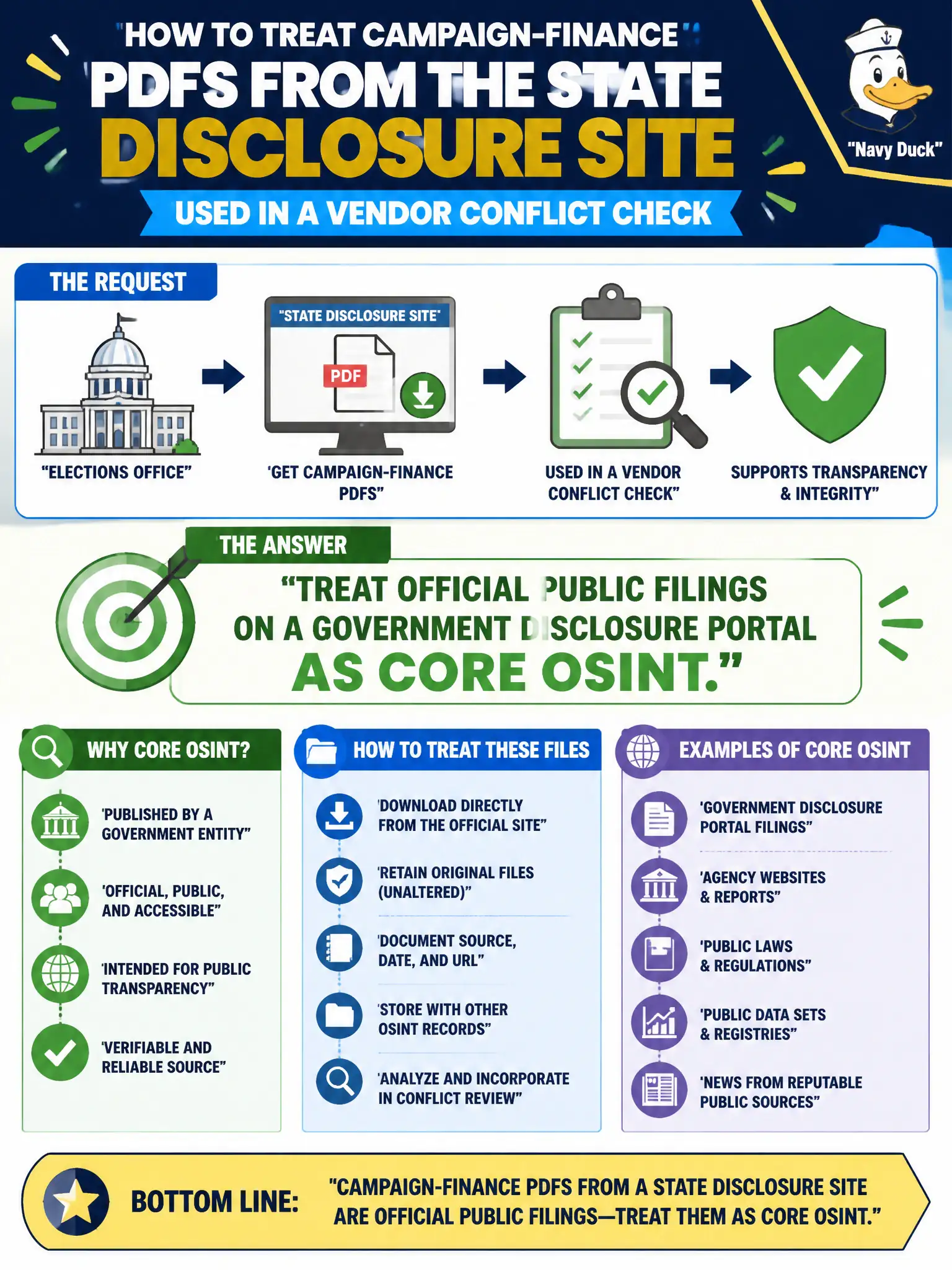
If the state hangs the binder in a public reading room, that binder is an open source. Campaign-finance PDFs on a disclosure site are exactly that kind of filing. They are fair game for a vendor conflict check.
Full Explanation
Official disclosure portals are core civic OSINT sources. Campaign-finance PDFs published on a state disclosure site are public filings and are appropriate for a vendor conflict check when used within elections-office and procurement policy. Ignoring them because government PDFs are never open source contradicts how civic OSINT actually works and discards high-value structured disclosures. Treating them as sealed political intelligence that OSINT cannot touch invents a ban that the disclosure regime itself rejects by publishing the files. Requiring donor consent before using already-published filings adds a hurdle the public portal does not impose and stalls routine conflict screening. Analysts should still read carefully and avoid overclaiming relationships beyond what the schedules show. Exam caveat: be precise about contributions, dates, and committees, and avoid asserting motive or hidden control that the document does not establish. Operational check: download or capture the filing from the official portal, record the URL and retrieval date, and cite the specific schedule or entry that supports the conflict question. Keep the civic purpose, method limits, and exhibit labels aligned so reviewers can see what was public-source work versus other authorities.