
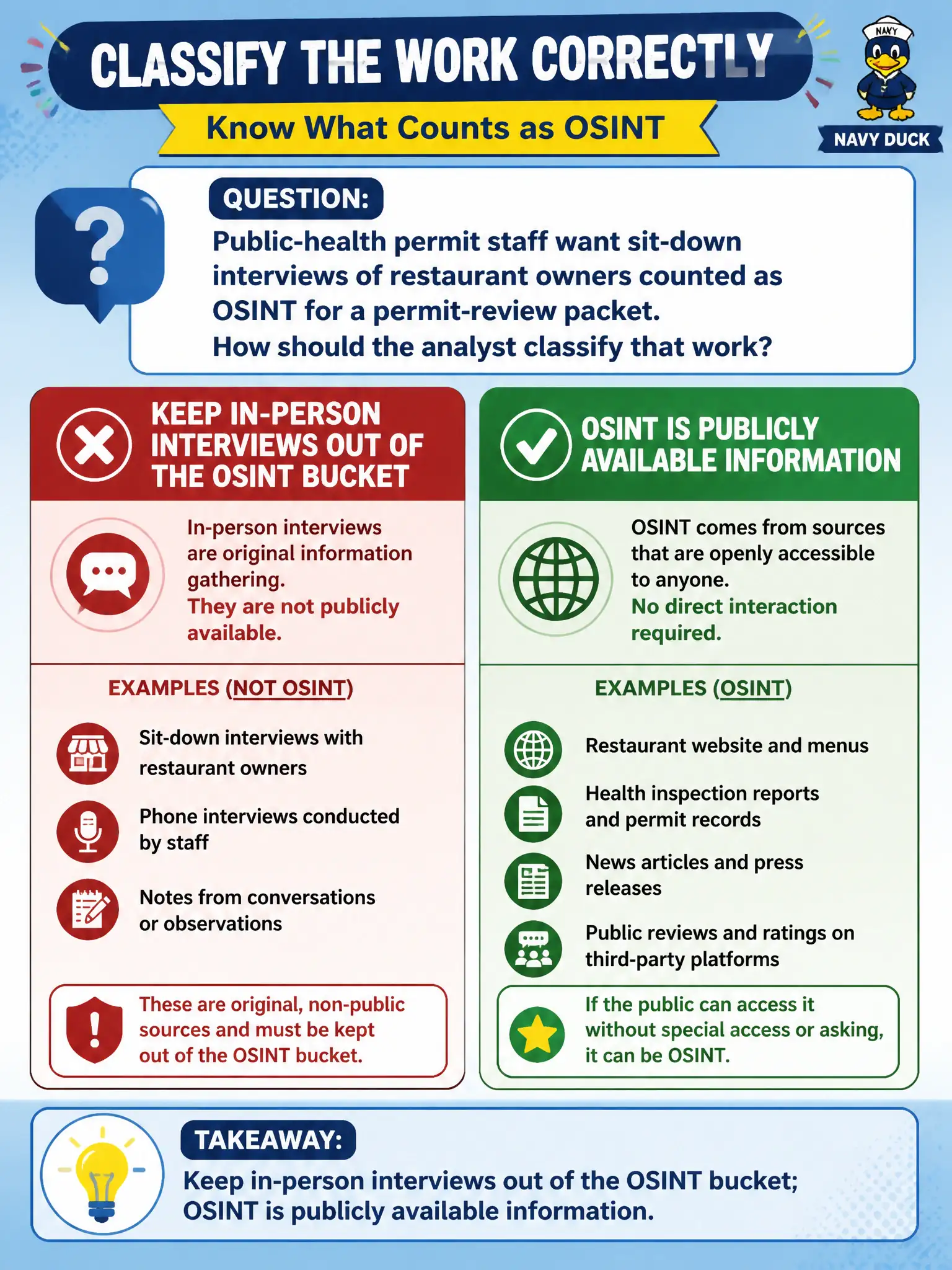
Public-health permit staff want sit-down interviews of restaurant owners counted as OSINT for a permit-review packet. How should the analyst classify that work?
Select an answer to reveal the explanation.
Short Explanation
Chatting with the chef is not the same as reading the posted inspection on the door. Interviews are human-source work. OSINT stays with what is already publicly available.
Full Explanation
OSINT is publicly available information. Sit-down interviews of restaurant owners are primary human collection, not a PORP public-source method, even when the owners are members of the public and the topic is a permit review. Calling every interview OSINT because the subjects are civilians conflates public-person status with public-source status and mislabels the method in the packet. Recording interviews secretly so the files become open-source artifacts neither creates public availability nor satisfies ethical collection norms for civic work. Replacing public-record and open-web checks with interviews merely because conversation is faster abandons the OSINT lane for convenience and loses documentary anchors. Interviews may still inform the broader investigation when authorized, but they belong in a separate method category. Exam caveat: interviews can complement OSINT under other authorities, yet they must be labeled and handled outside the OSINT section of the permit-review packet. Operational check: tag each exhibit as public-source OSINT or interview/HUMINT-equivalent; if an item required a conversation to exist, keep it out of the OSINT section. Keep the civic purpose, method limits, and exhibit labels aligned so reviewers can see what was public-source work versus other authorities.