
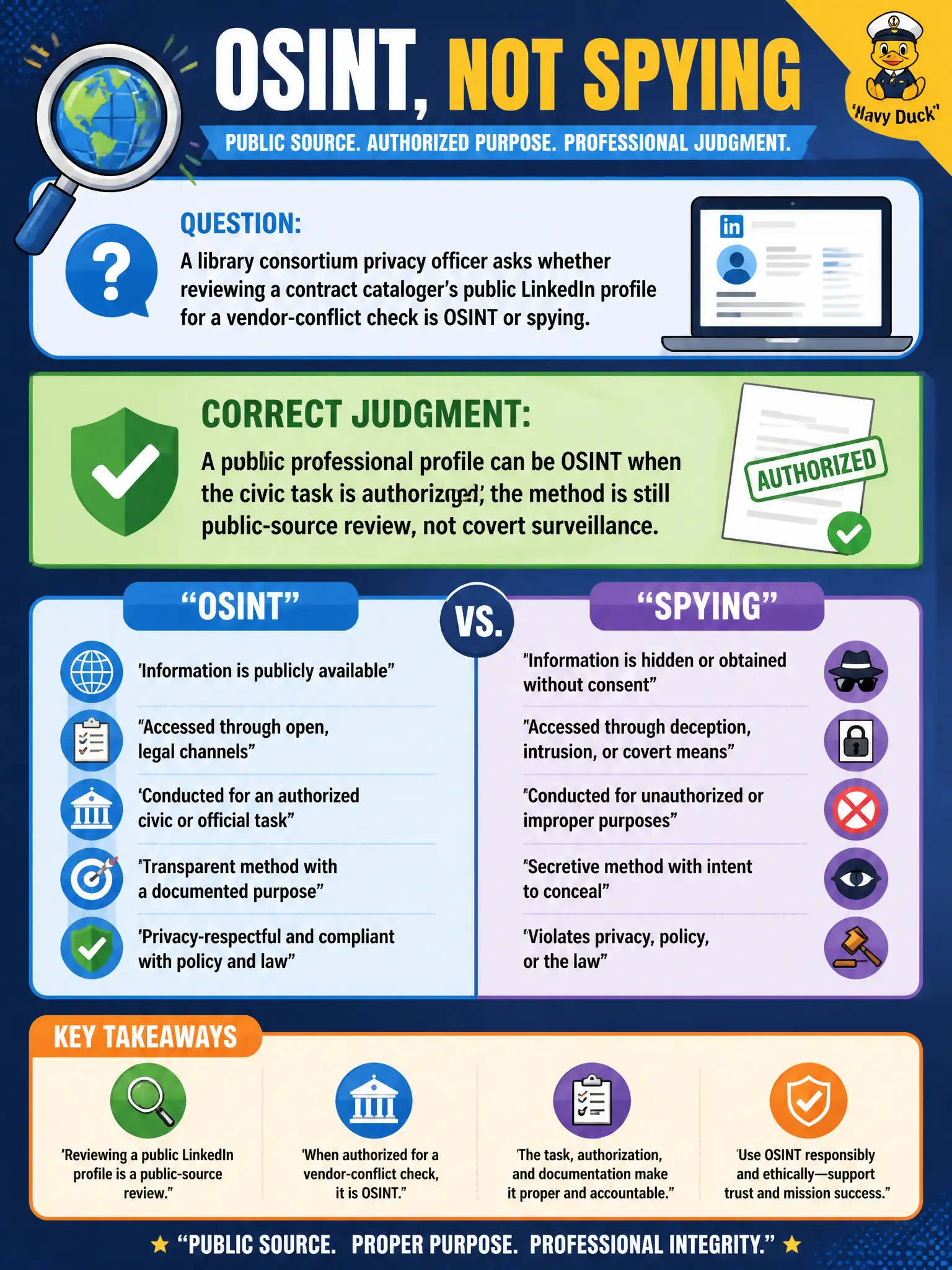
A library consortium privacy officer asks whether reviewing a contract cataloger's public LinkedIn profile for a vendor-conflict check is OSINT or spying. What is the correct judgment?
Select an answer to reveal the explanation.
Short Explanation
Reading a flyer taped in the shop window is not hiding in the back office. A public professional profile is an open source when the library has a legitimate vendor-conflict task. The method stays public-source review, not covert watching.
Full Explanation
Public professional profiles are ordinary OSINT sources when collection serves an authorized civic purpose such as a vendor-conflict check. Reviewing a contract cataloger's public LinkedIn information is public-source review, not covert surveillance, provided the analyst stays within what is publicly visible and the task is authorized by the library consortium's process. Declaring any look at a LinkedIn page illegal surveillance regardless of purpose erases the public/private distinction that OSINT depends on and would disable routine due diligence. Claiming public profiles become closed sources the moment a city employee views them confuses viewer identity with source availability. Requiring the analyst to friend the cataloger under a fake name before the review counts as OSINT is unnecessary for public content and risks unauthorized social engineering. Exam caveat: platform terms, local policy, and privacy expectations still constrain how profiles are stored, shared, and retained in a civic file. Operational check: capture only publicly visible fields needed for the conflict question, record the profile URL and retrieval time, and avoid connection requests or private-message pivots that leave the public surface.