
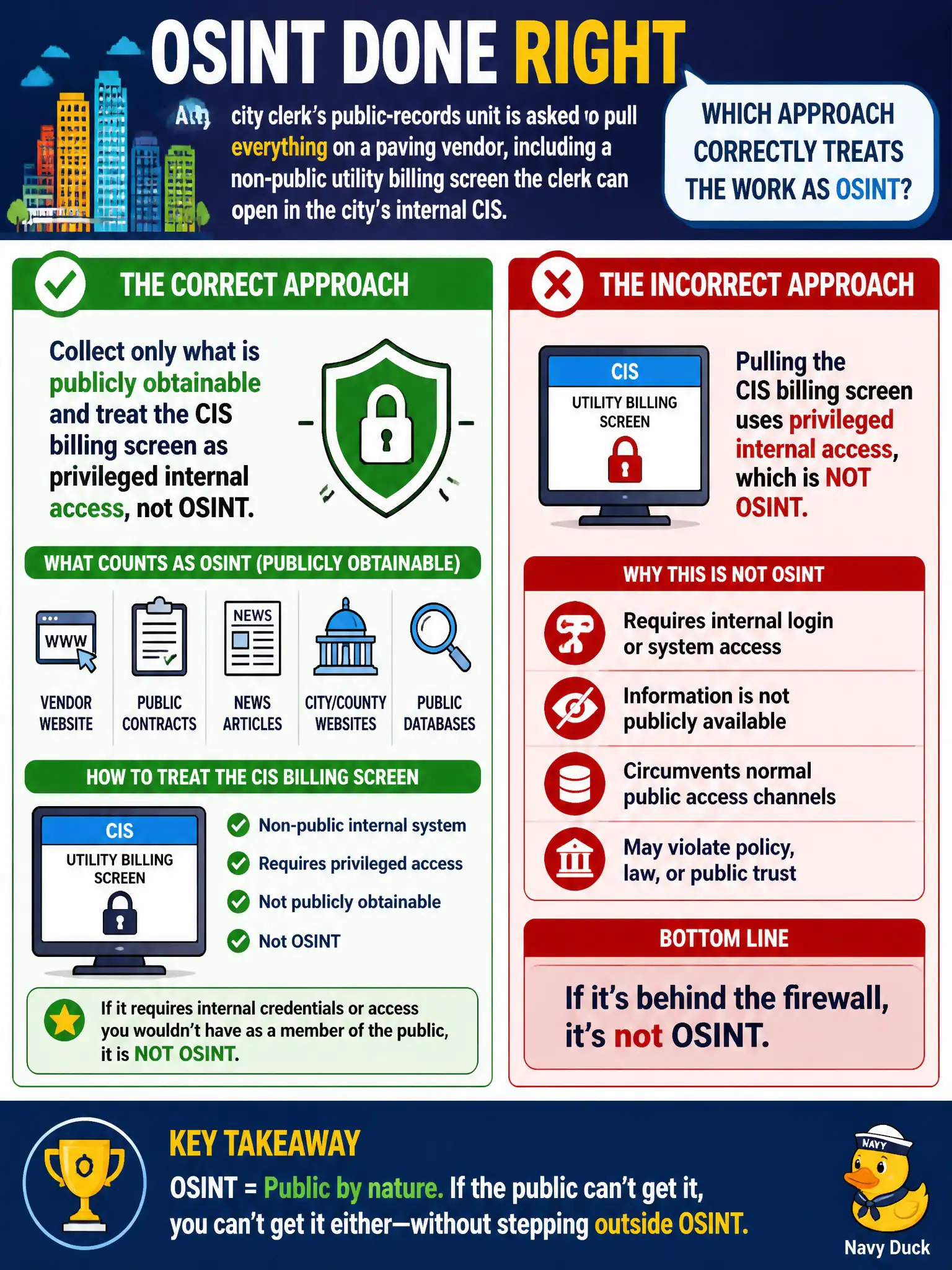
A city clerk's public-records unit is asked to pull everything on a paving vendor, including a non-public utility billing screen the clerk can open in the city's internal CIS. Which approach correctly treats the work as OSINT?
Select an answer to reveal the explanation.
Short Explanation
Think of OSINT like shopping from the storefront, not walking into the stockroom with a staff key. The clerk's CIS billing screen is an internal privilege, not something any member of the public can pull. Open-source work stops at what is publicly obtainable.
Full Explanation
OSINT collection is limited to publicly available sources. In a municipal paving-vendor review, role-based access to a city customer-information system (CIS) utility-billing screen is privileged internal access, not open-source collection, even when the same clerk also handles public-records requests. Treating that screen as the primary OSINT source collapses the boundary between workplace privilege and public availability and mislabels closed operational data as open source. Dumping the billing screen into an OSINT folder and calling it open source because a government employee collected it likewise fails: collector identity does not convert non-public records into public ones. Skipping public filings, news, maps, and other openly obtainable artifacts in favor of CIS completeness abandons the OSINT method entirely and substitutes an internal records pull. Exam caveat: authorized staff may still obtain CIS data through a separate, properly scoped records or investigation process when policy allows, but that stream must stay labeled and handled outside the OSINT product. Operational check: before filing an exhibit, ask whether a member of the public without city credentials could lawfully obtain the same artifact from a public channel; if not, keep it out of the OSINT lane and document any internal access under its own authority.