
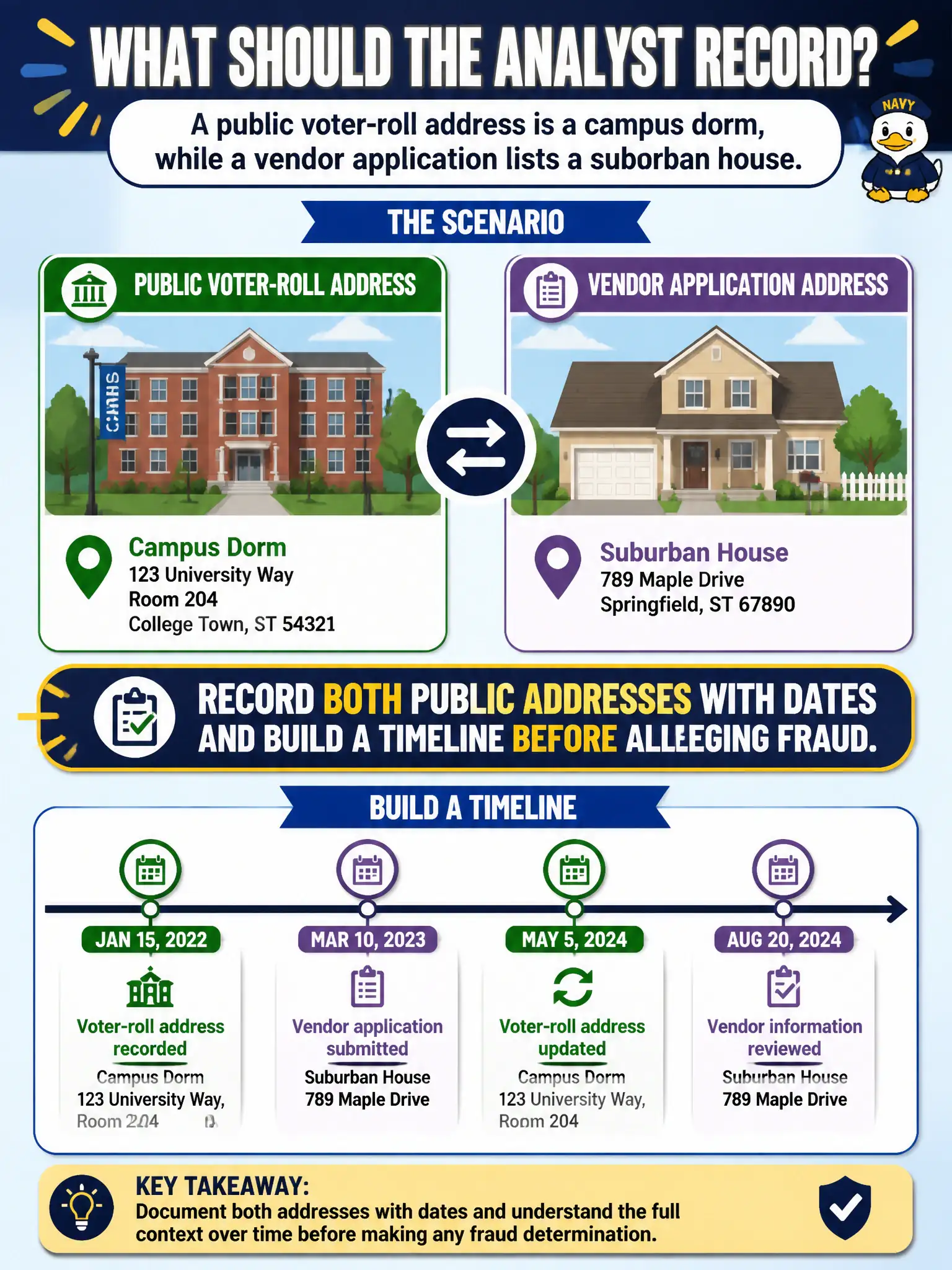
A public voter-roll address is a campus dorm, while a vendor application lists a suburban house. What should the analyst record?
Select an answer to reveal the explanation.
Short Explanation
People move—dorm one year, house the next—and public records lag. Two addresses are two dated facts, not an instant fraud stamp. Keep both, line them up in time, and only then decide whether something still looks wrong.
Full Explanation
When a public voter-roll address shows a campus dorm while a vendor application lists a suburban house, the analyst should record both public addresses with dates and build a timeline before alleging fraud. People move, and public records lag; dorm-to-house transitions are common and not inherently deceptive. Labeling the applicant a fraudster from the address mismatch alone skips chronology and alternative explanations such as student housing versus later residence. Deleting the voter-roll address because people “may have only one home ever” destroys a dated public fact. Amending the voter roll without elections-office authority tampers with an official civic dataset OSINT does not control. Exam caveat: PORP requires dated multi-address timelines before fraud allegations from residential mismatches. Operational check: cite voter-roll edition and vendor-application date for each address, order them on a timeline, note plausible move explanations, escalate only residual anomalies through proper vendor-risk or elections channels, and never edit the voter roll as an analytic “fix.” Vendor-risk memos stay credible when they present dorm and house as dated coexisting public facts rather than as an automatic fraud narrative.