
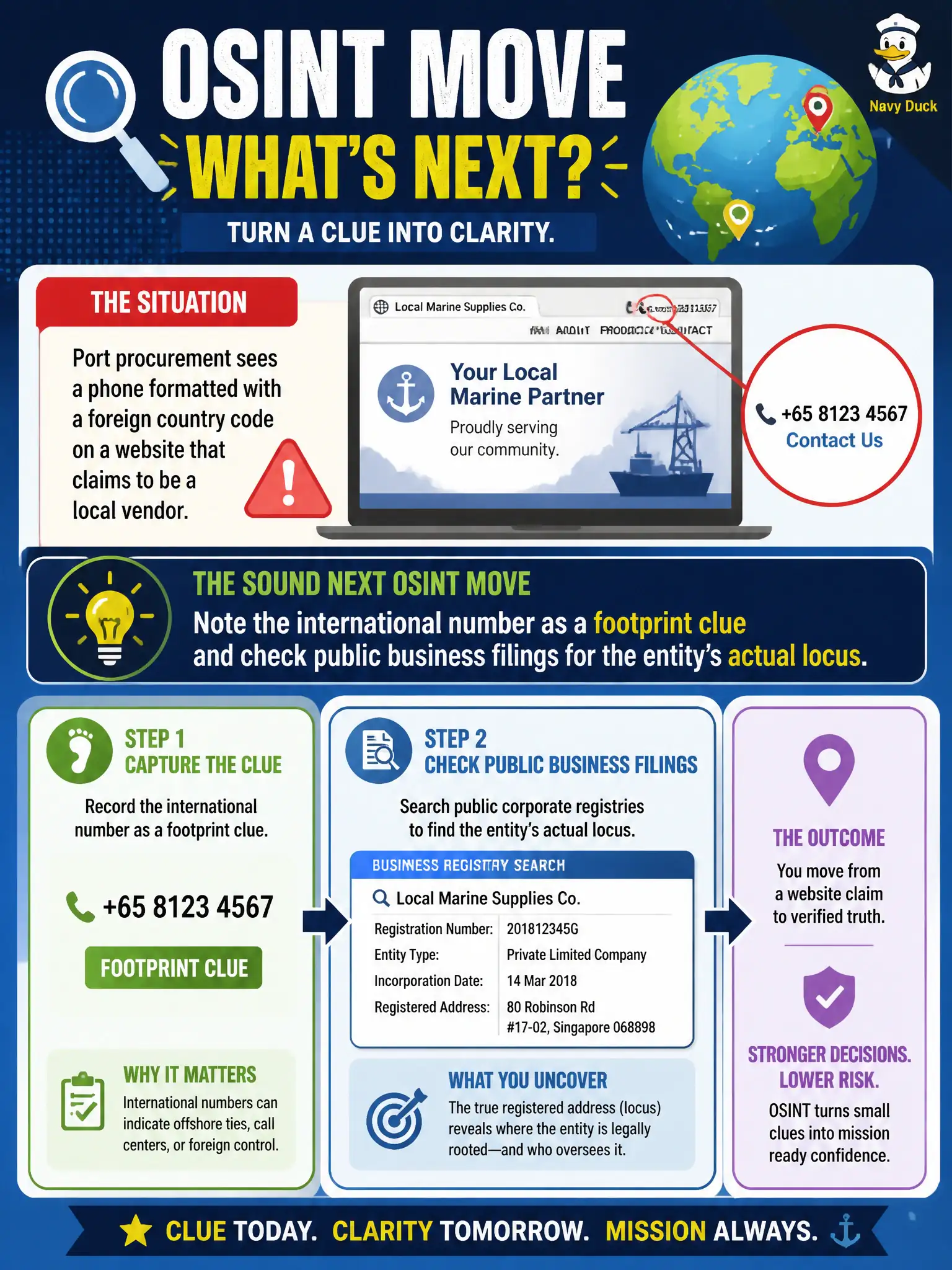
Port procurement sees a phone formatted with a foreign country code on a website that claims to be a local vendor. What is the sound next OSINT move?
Select an answer to reveal the explanation.
Short Explanation
A foreign country code on a “local” vendor site is a flag on the map, not the whole story. Write it down, then look at public filings to see where the company actually lives. Do not award, convict, or hang up the city’s phones on that digit string alone.
Full Explanation
When port procurement sees a phone formatted with a foreign country code on a website that claims to be a local vendor, the sound next OSINT move is to note the international number as a footprint clue and check public business filings for the entity’s actual locus. Country codes are signals about telephony footprint, not complete company biographies. Awarding the contract because foreign numbers “prove sophistication” ignores a possible mismatch with a local-vendor claim. Treating the country code as conclusive proof of a criminal syndicate overreads a digit string into organized-crime certainty. Blocking the number at the city’s PBX as the entire investigation substitutes a network control for entity research and may not even address the procurement risk. Exam caveat: PORP treats foreign country codes on purportedly local vendor sites as footprint leads to be tested against public filings, not as award criteria, syndicate proof, or PBX-only responses. Operational check: record the E.164 number and page URL, pull public business-registry filings, compare claimed local address to filing locus and officers, brief procurement on consistency or mismatch, and leave PBX blocks to IT only as a separate operational decision—not as the investigation’s end.