
Clerk staff find a public birth-index listing, in a state that publishes indexes, that may distinguish two same-name contractors. What is the correct OSINT use of that index?
Select an answer to reveal the explanation.
Short Explanation
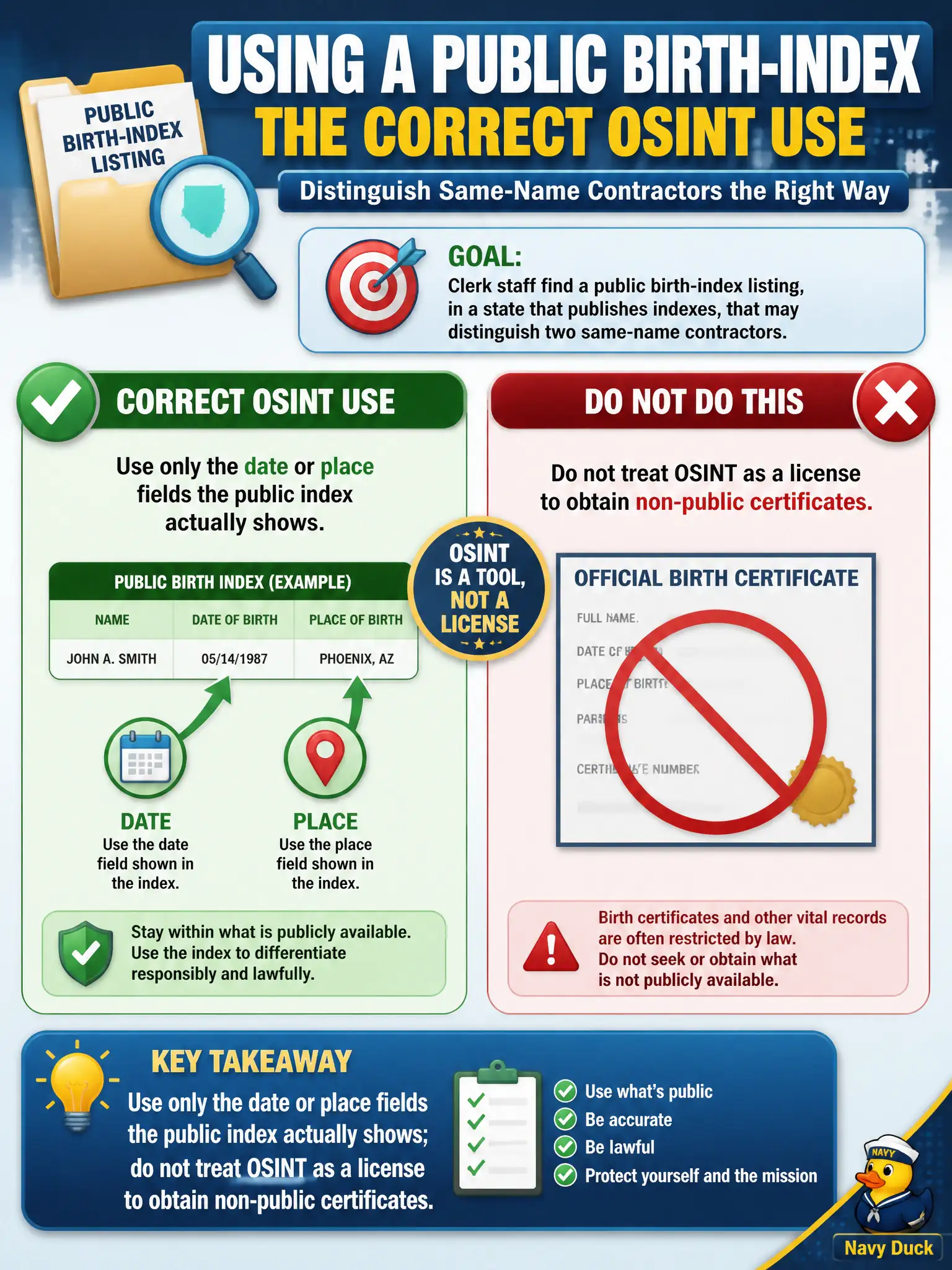
A public birth index is a card catalog, not the vault. Use the date and place fields the state actually posted to tell two same-name contractors apart. Ordering sealed certificates is a records request of a different kind, not OSINT.
Full Explanation
Where a state publishes a public birth-index listing, clerk staff may use only the date or place fields the public index actually shows to help distinguish two same-name contractors; OSINT is not a license to obtain non-public certificates. Indexes are card-catalog style publications, not the sealed long-form record. Ordering each contractor’s sealed long-form birth certificate as routine OSINT converts a public-index tip into a restricted vital-records pull. Assuming the index is private and refusing to cite a published state page wrongly abandons a lawful open source the state chose to post. Merging both contractors into one person because the index shows a similar year overreads a coarse date field into identity certainty. Exam caveat: PORP limits vital-records OSINT to published index fields and forbids treating index hits as authority for sealed certificates. Operational check: cite the index URL, extract only published date or place fields, apply them as soft disambiguators between same-name contractors, keep sealed certificate requests on a separate lawful track if ever needed, and leave the two contractor files unmerged until stronger identifiers appear. Same-name contractor disambiguation improves when public index fields are quoted precisely and sealed certificates remain off the OSINT checklist.