
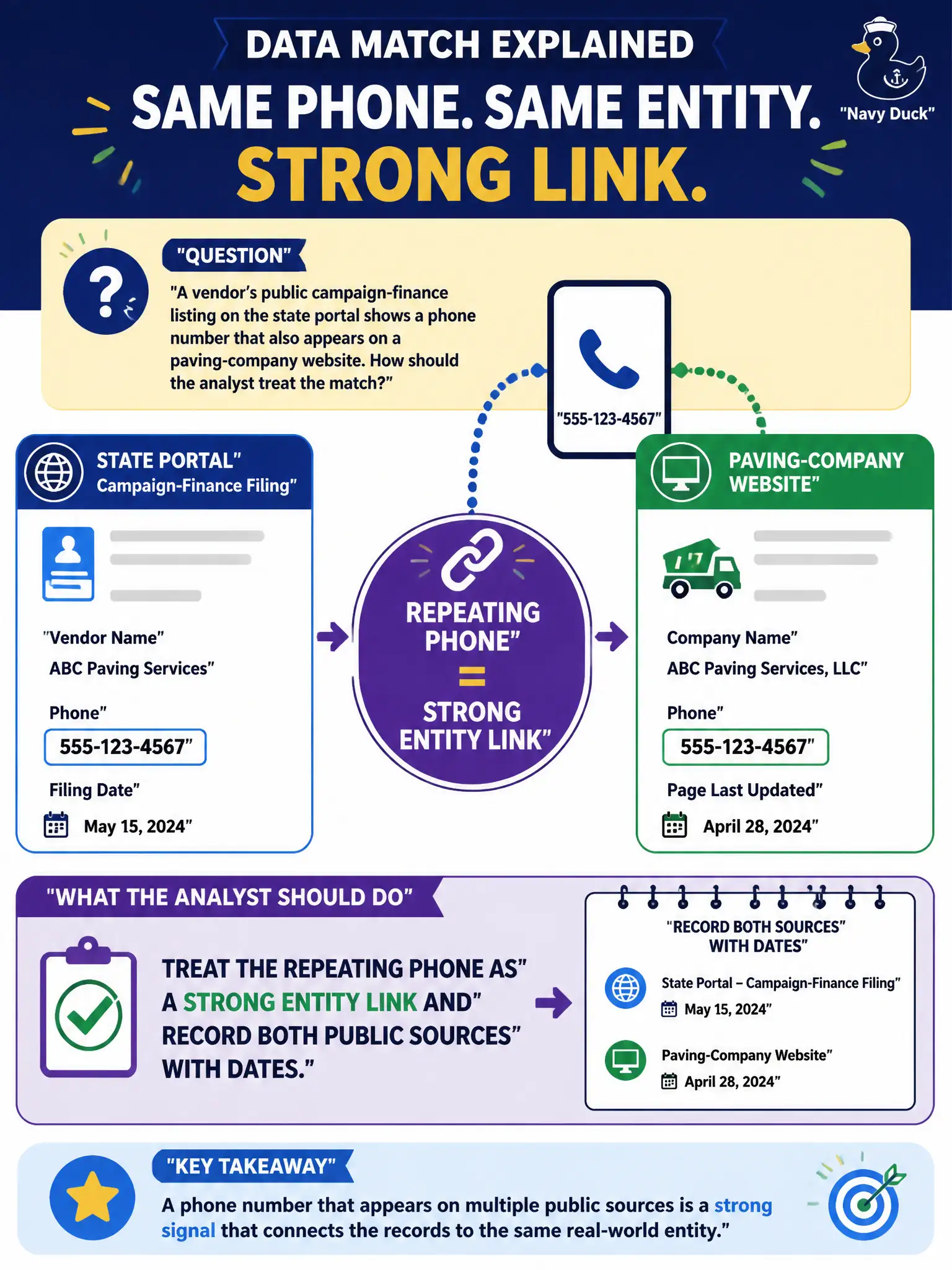
A vendor’s public campaign-finance listing on the state portal shows a phone number that also appears on a paving-company website. How should the analyst treat the match?
Select an answer to reveal the explanation.
Short Explanation
The same phone on a state filing and a paving site is two name tags on the same coat. That is a strong public link—cite both pages with dates. It is not a courtroom verdict, and it is not a reason to play ethics-board theater on the phone.
Full Explanation
When a vendor’s public campaign-finance listing on the state portal shows a phone number that also appears on a paving-company website, the analyst should treat the repeating phone as a strong entity link and record both public sources with dates. Cross-publication of the same number is a classic identity pivot between a political filing and a commercial site. Ignoring it because campaign-finance phones are “never” identity pivots discards a high-value public signal. Accusing the vendor of a crime solely because one number appeared twice mistakes corroboration for culpability; many lawful entities reuse contact numbers. Calling the number while impersonating the ethics board is pretexting and unauthorized impersonation of a civic authority. Exam caveat: PORP scores repeated public phones as strong entity links requiring citation, not as standalone crime proof or a license to spoof officials. Operational check: archive both URLs with retrieval dates, quote the shared number exactly, enter a linked-entity note in the due-diligence file, avoid charging language from the match alone, and refuse impersonation calls while routing ethics concerns through proper channels. Procurement and ethics reviewers can act on a well-cited phone link without the analyst performing courtroom accusations or impersonation calls.