
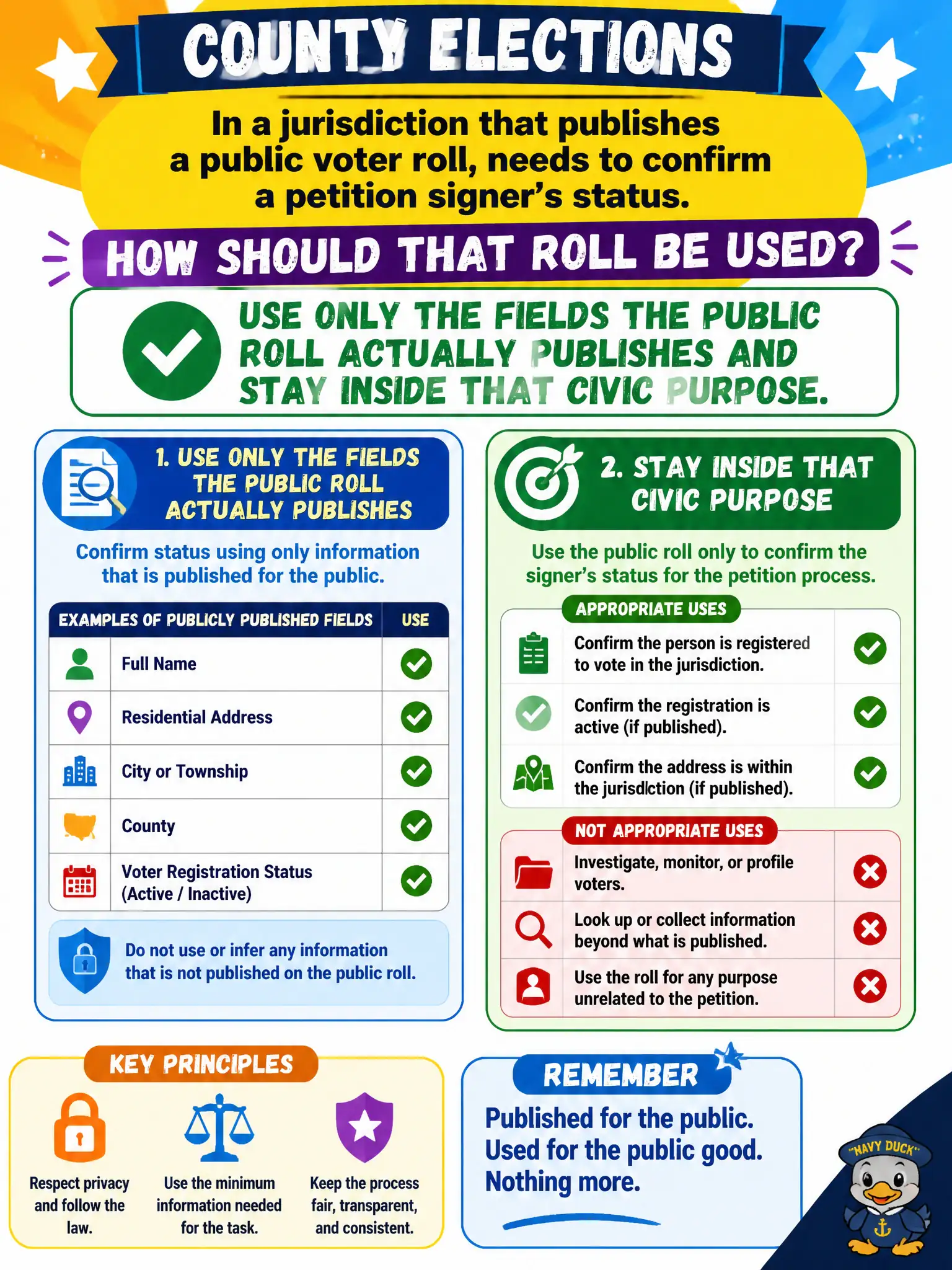
County elections, in a jurisdiction that publishes a public voter roll, needs to confirm a petition signer’s status. How should that roll be used?
Select an answer to reveal the explanation.
Short Explanation
A public voter roll is a published roster, not a backstage pass. Use the fields the county actually put on the public side, for the petition check you were asked to do. Sealed ballots, restricted jury lists, and social-media dumps are a different sport.
Full Explanation
In jurisdictions that publish a public voter roll, county elections may use only the fields that roll actually publishes—and only for the civic purpose of confirming a petition signer’s status. Public-roll use is purpose-limited and field-limited even when the roster is open. Downloading sealed absentee-ballot images because petitions “need extra proof” exceeds the public roll and typical OSINT authority over election materials. Enriching signers from non-public jury lists on restricted court terminals leaves the open-source lane for systems that require separate access rules. Posting a signer’s full roll row on social media as a deterrent is misuse of public records and can chill lawful petition participation. Exam caveat: PORP allows public-roll civic use inside published fields and purpose limits, never sealed election materials or punitive doxxing. Operational check: query only public roll fields needed for signer confirmation, cite the roll edition and date, store minimally for the petition task, refuse social amplification of full rows, and escalate any need for non-public election data through official elections processes—not OSINT improvisation. Petition checks stay defensible when the notebook shows which public fields were used and that sealed or restricted election systems were never queried as OSINT.