
Parks finds a VoIP number on an illegal dump-site flyer. What should phone OSINT infer about location?
Select an answer to reveal the explanation.
Short Explanation
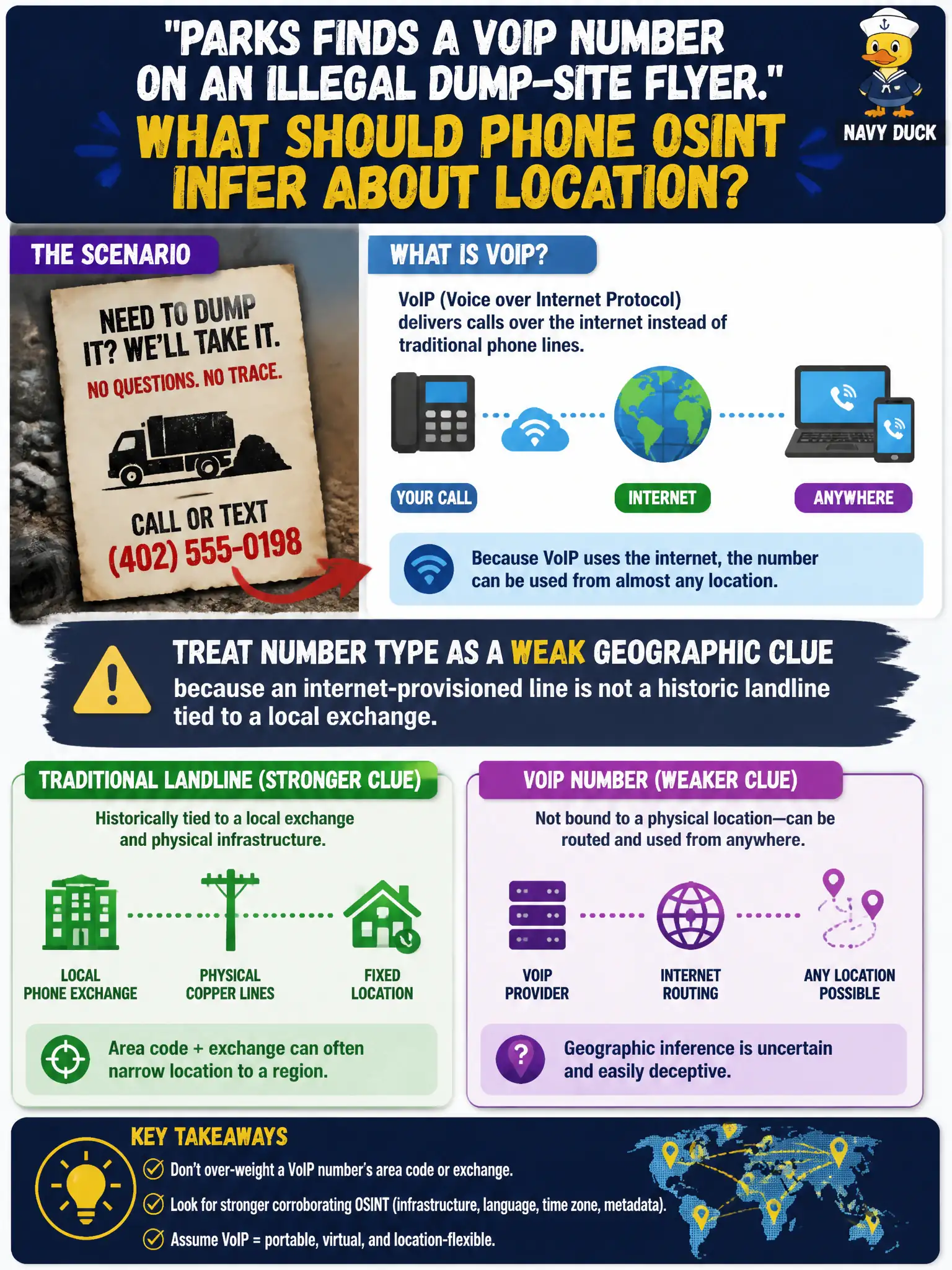
A VoIP number is a mailbox you can put anywhere; an old landline was nailed to a street. Number type changes how much place you can honestly infer. Do not pin the dump to a house—or to another country—on the digits alone.
Full Explanation
A VoIP number on an illegal dump-site flyer is a weak geographic clue because an internet-provisioned line is not a historic landline tied to a local exchange. Parks phone OSINT should treat number type as informative for triage but not as a house-level locator for the dump. Mapping the flyer to a specific residence because “every VoIP number encodes a street address” invents precision providers do not publish in ordinary public reverse lookups. Assuming the dump is overseas solely because the line is VoIP overgeneralizes; domestic VoIP with local-looking numbers is common. Skipping number-type research discards a useful, if limited, signal that helps analysts avoid landline-style overclaiming. Exam caveat: PORP teaches line-type interpretation without overclaiming VoIP geolocation from the digits alone. Operational check: classify the number via public lookup tools, note VoIP or non-geographic character, search the digits on public pages and the flyer archive, geolocate the dump from scene imagery and parcel facts rather than from the phone, and avoid assigning a household from the number alone while documenting residual geographic uncertainty. Dump-site geography should come from imagery, witnesses, and parcels; the VoIP digits mainly warn the analyst not to treat the line like a neighborhood landline.