
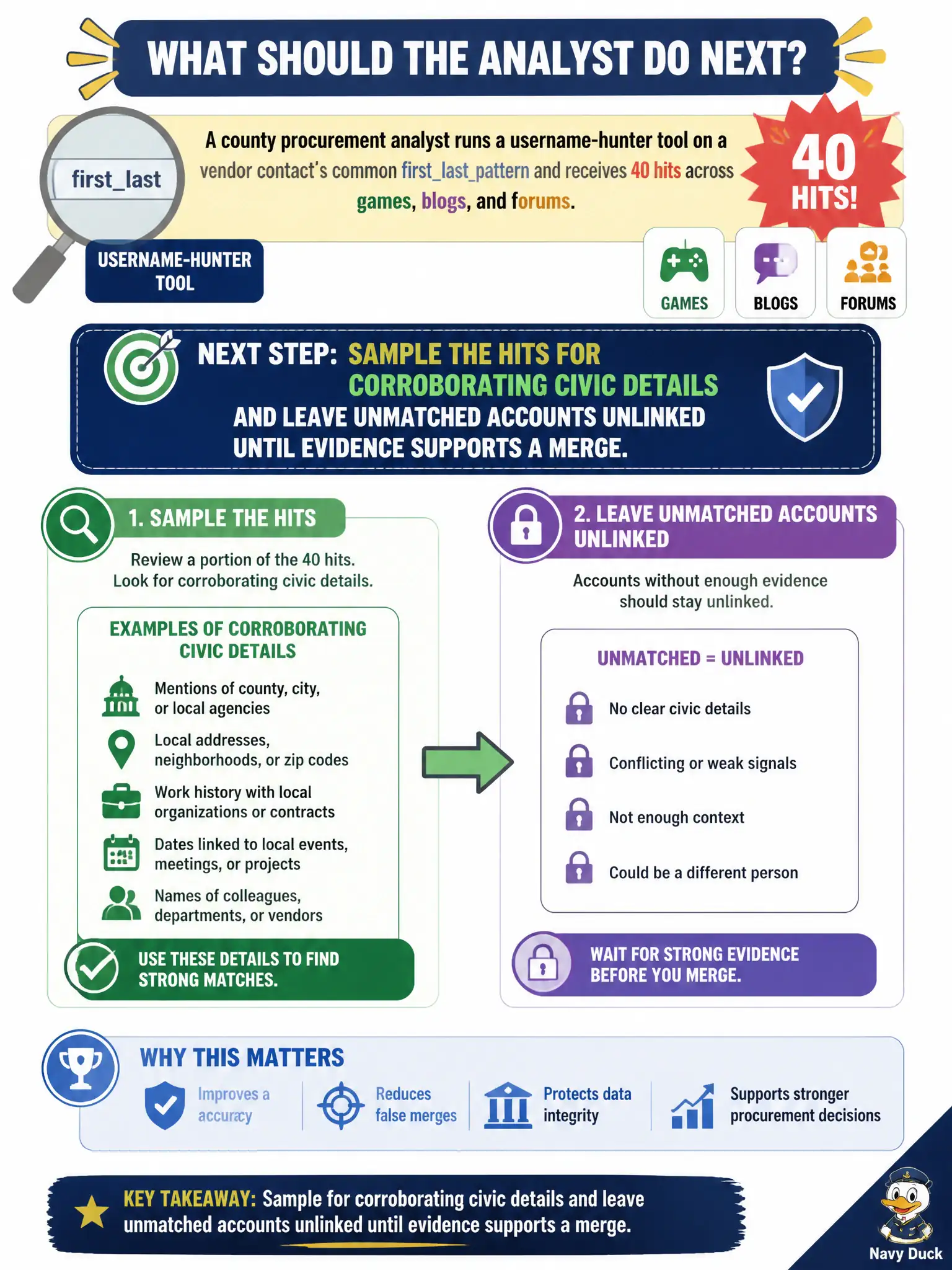
A county procurement analyst runs a username-hunter tool on a vendor contact’s common first_last pattern and receives 40 hits across games, blogs, and forums. What should the analyst do next?
Select an answer to reveal the explanation.
Short Explanation
A hunter tool is a metal detector on a crowded beach—it beeps constantly, and most beeps are bottle caps. Sample those 40 hits against civic context and keep only accounts that actually corroborate the vendor. Dumping the whole pile into the report just staples strangers to the company.
Full Explanation
When a county procurement analyst runs a username-hunter tool on a vendor contact’s common first_last pattern and receives forty hits across games, blogs, and forums, the next step is to sample those hits for corroborating civic details and leave unmatched accounts unlinked until evidence supports a merge. Common name patterns collide heavily, so string matches alone do not prove the vendor owns every account. Attaching every hit to the vendor in the due-diligence report because the string matched staples strangers’ hobby accounts to a company file and pollutes risk judgments. Loading all forty URLs into the city’s CRM as verified vendor contacts treats speculative OSINT as master data. Asking a platform to suspend all forty accounts as impersonation of the vendor weaponizes a weak string match into takedown requests without proof. Exam caveat: PORP requires selective corroboration after username-hunter sweeps, especially on common first_last patterns. Operational check: score each hit against civic context such as employer text, project names, or matching emails; archive only corroborated profiles; explicitly mark the remainder unlinked; and refuse bulk CRM import or mass suspension requests based on the hunter output alone.