
Library staff doing public-facing research on a contractor find an old resume that omits a bankruptcy news story. How should people OSINT treat those sources?
Select an answer to reveal the explanation.
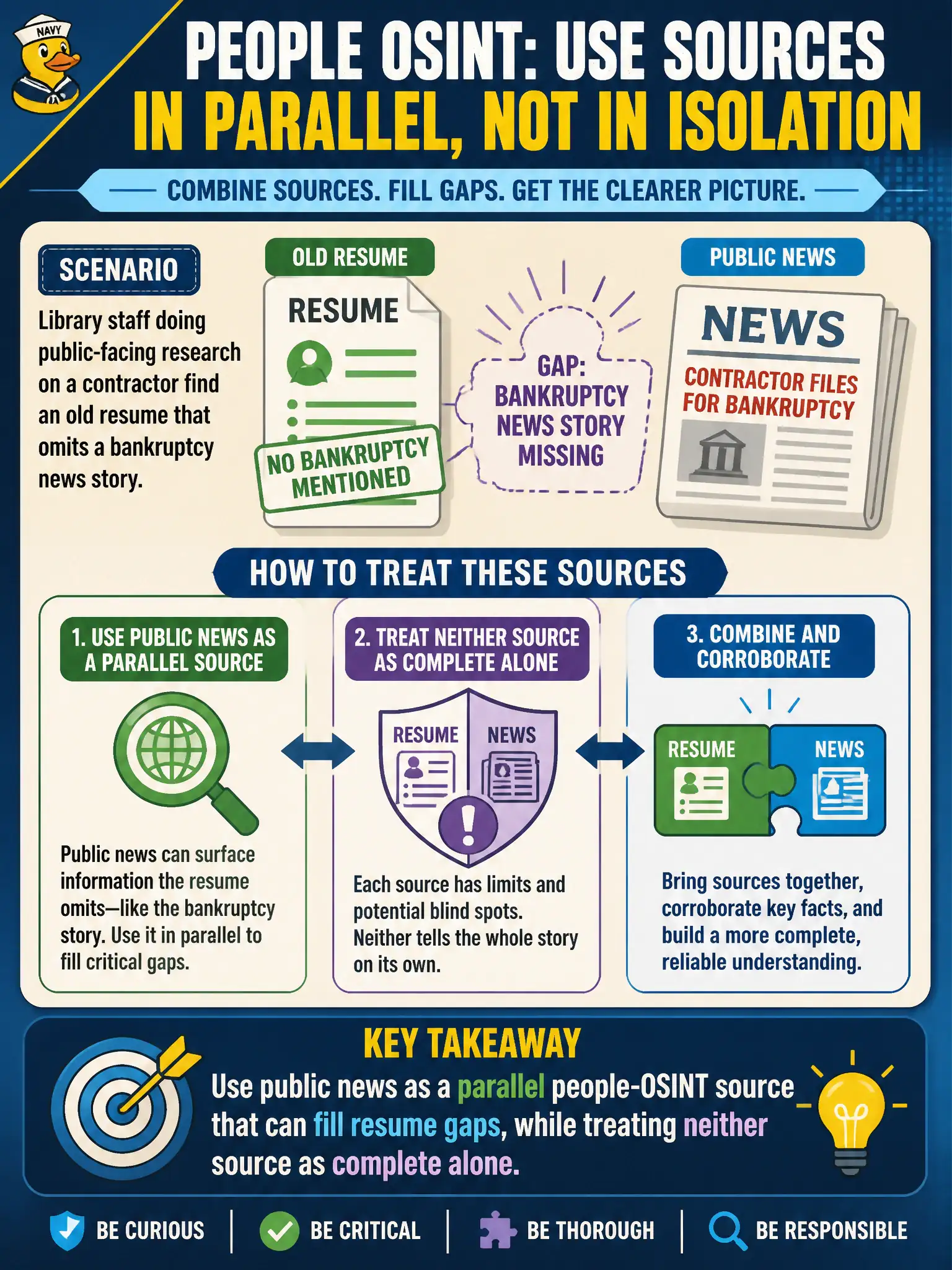
Short Explanation
Resumes are highlight reels; news clips are someone else's camera. Run both reels and expect gaps in each. Library research on a contractor stays in public sources—not another city's HR cabinet.
Full Explanation
When library staff doing public-facing research on a contractor find an old resume that omits a bankruptcy news story, people OSINT should use public news as a parallel source that can fill resume gaps while treating neither source as complete alone. Self-curated resumes omit unfavorable facts by design; journalism and court-adjacent public reporting can supply missing timeline context without replacing the resume’s career claims. Trusting only the resume and ignoring public news because resumes are “self-curated truth” abandons corroboration that civic library research is supposed to practice. Pulling the contractor’s private HR file from another city’s intranet leaves the public-source lane and may violate access rules of that other government. Treating a news headline as a substitute for reading the resume at all skips primary career-timeline content the PDF still holds for titles, dates, and employers. Exam caveat: PORP expects dual use of self-published career materials and independent public reporting, with each labeled by bias and completeness limits. Operational check: archive resume and news URLs with dates, extract overlapping and conflicting facts, note resume omissions without moralizing, keep collection inside public sources, and brief library stakeholders on both artifacts together.