
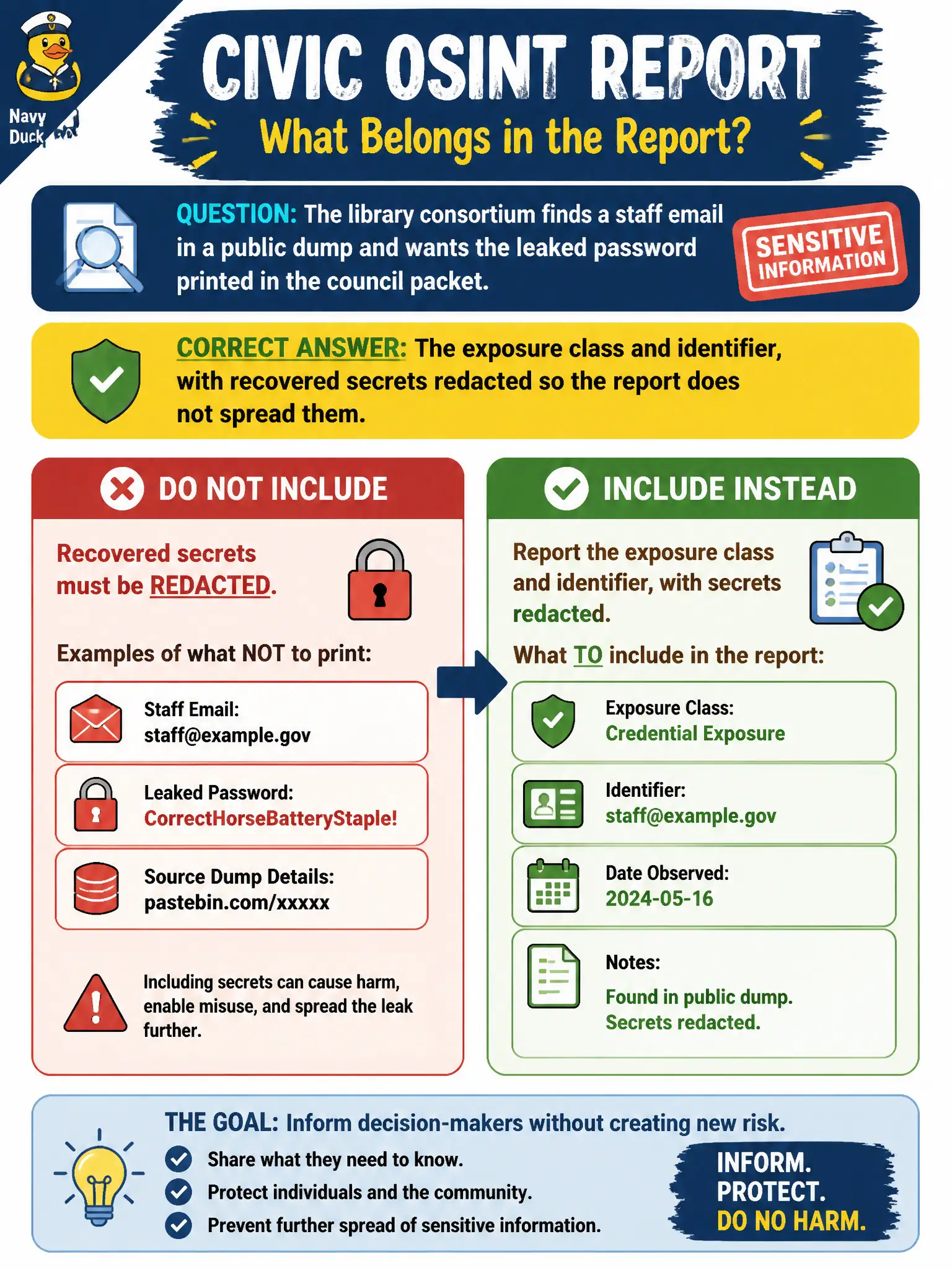
The library consortium finds a staff email in a public dump and wants the leaked password printed in the council packet. What belongs in the civic OSINT report?
Select an answer to reveal the explanation.
Short Explanation
Council packets are the town bulletin board. You can say an identifier showed up in a dump. You do not reprint the spare key for everyone in the gallery.
Full Explanation
When the library consortium finds a staff email in a public dump and wants the leaked password printed in the council packet, the civic OSINT report should include the exposure class and identifier with recovered secrets redacted so the report does not spread them. Council packets are widely circulated civic records; reprinting usable secrets multiplies harm to the staff member and anyone else who reuses that password. Putting the full recovered password in plaintext “for transparency” is transparency theater that creates new disclosure risk inside an already public process. Attaching a copy of the entire dump file to the public agenda dumps unrelated victims’ data into the public square far beyond the library’s need. Instructing the public to reuse the leaked password on library Wi-Fi weaponizes the finding against municipal infrastructure. Exam caveat: PORP exposure reporting names identifiers and dump context while redacting secrets from civic distributions such as council packets. Operational check: state that the identifier appeared in a named public corpus with date; redact password and hash material; notify IT or the staff member through approved channels; recommend forced reset and monitoring; and keep raw dump artifacts in a restricted working file, not the public agenda.