
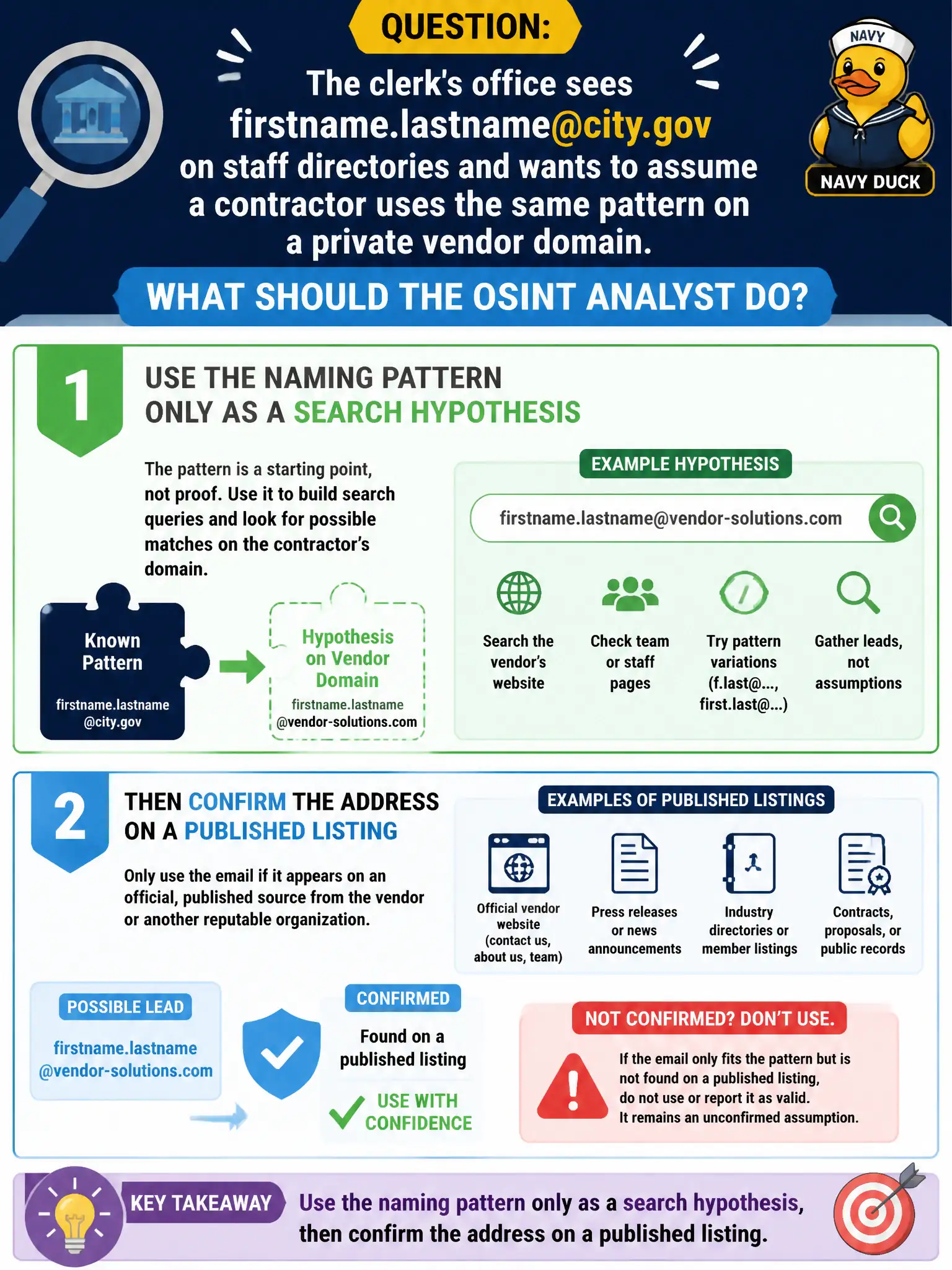
The clerk's office sees [email protected] on staff directories and wants to assume a contractor uses the same pattern on a private vendor domain. What should the OSINT analyst do?
Select an answer to reveal the explanation.
Short Explanation
A naming pattern is a treasure map, not the treasure. It tells you what to search for; it does not prove the mailbox exists. Confirm the address on a page, PDF, or filing before the clerk treats it as real.
Full Explanation
Staff-directory patterns such as [email protected] are useful search hypotheses, not proof that a contractor’s mailbox exists on a private vendor domain. The OSINT analyst should use the pattern to craft queries and filename searches, then confirm any candidate address on a published listing—webpage, PDF, registry, invoice footer, or proposal—before recording it as confirmed in the civic file. Mailing every guessed contractor address until one delivers is active probing outside the OSINT lane and can be interpreted as harassment or reconnaissance. Treating the city pattern as proof the contractor mailbox exists lists unverified addresses as facts and pollutes licensing or procurement due diligence. Copying the pattern onto the vendor domain while skipping published listings invents contacts and teaches stakeholders the wrong method. Exam caveat: PORP allows pattern-based hypotheses but requires published confirmation before addresses enter official vendor or licensing contact blocks. Operational check: document the hypothesized pattern, search for exact published matches, cite the confirming source with date and URL, leave unconfirmed guesses in a scratchpad only, and brief clerks that pattern similarity is not existence proof.