
A city utility PDF from several years ago still lists an employee's personal Gmail in the footer of an old fact sheet. What is the sound OSINT treatment of that address?
Select an answer to reveal the explanation.
Short Explanation
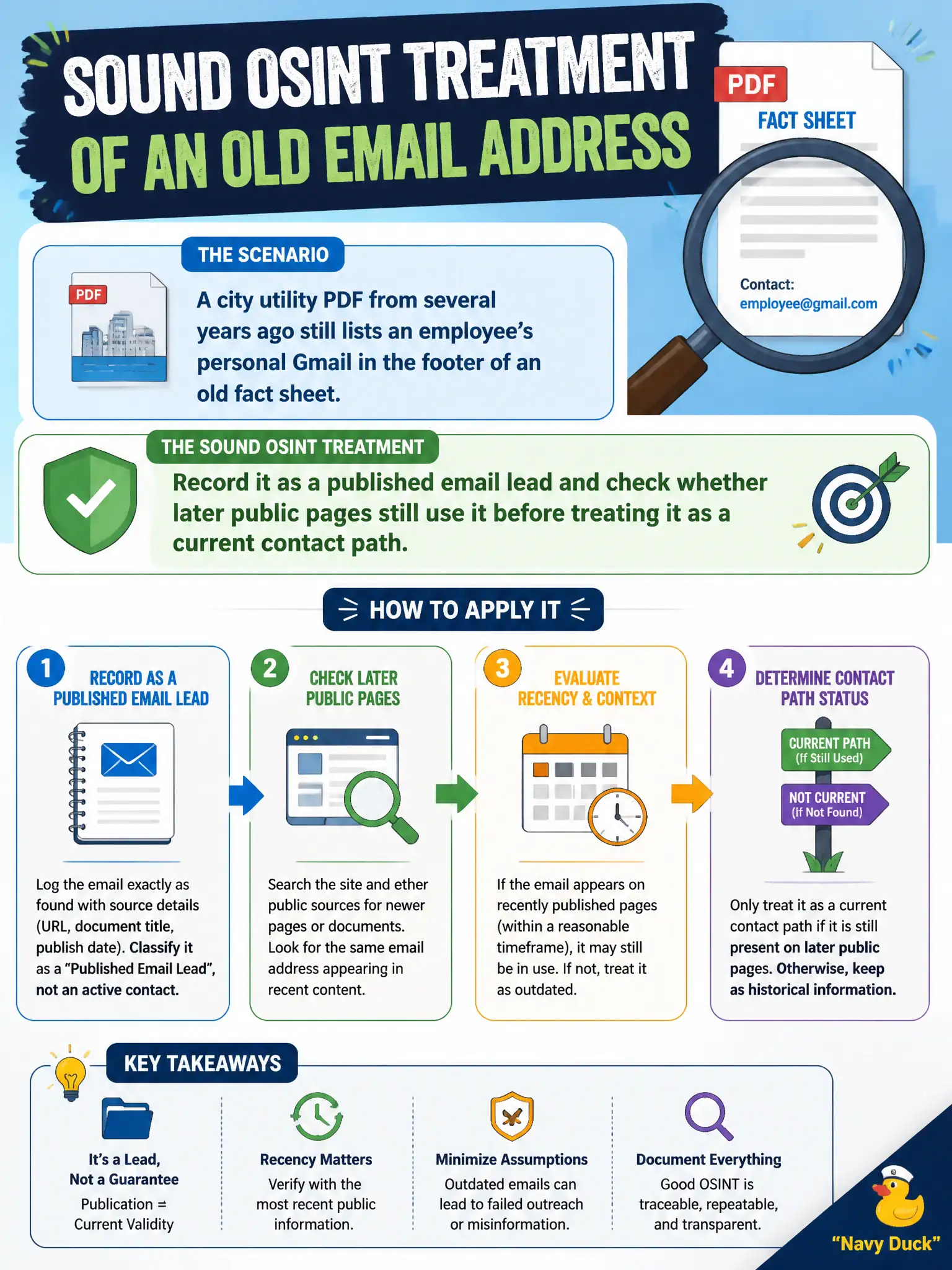
An old footer is a breadcrumb, not a live switchboard. Capture the published address, then see if newer public pages still show it. Treating a stale personal Gmail as today's official city mailbox is how briefings go sideways.
Full Explanation
Older civic PDFs and fact sheets sometimes retain an employee’s personal Gmail in a footer long after contact policy or role changed. The sound OSINT treatment is to record that address as a published email lead and check whether later public pages, directories, or signatures still use it before treating it as a current contact path. Routing operational city notices to a personal Gmail as if it were the official mailbox misuses a stale artifact and may violate records retention, privacy, and acceptable-use policy. Discarding personal addresses on civic PDFs as “never OSINT” is incorrect—they are public artifacts—but over-trusting them as live official channels is equally wrong. Using the Gmail to reset the employee’s city SSO because the PDF “proves ownership” is account-takeover behavior, not research, and creates security and liability exposure for the city. Exam caveat: PORP treats historical published emails as leads requiring recency validation, not as automatic live routing for civic operations. Operational check: capture the PDF URL, hash, and footer text; search newer directories for the same address; mark the lead stale if superseded; escalate stale PII exposure to records or privacy staff if needed; and never attempt SSO or mailbox recovery using personal addresses found in OSINT.