
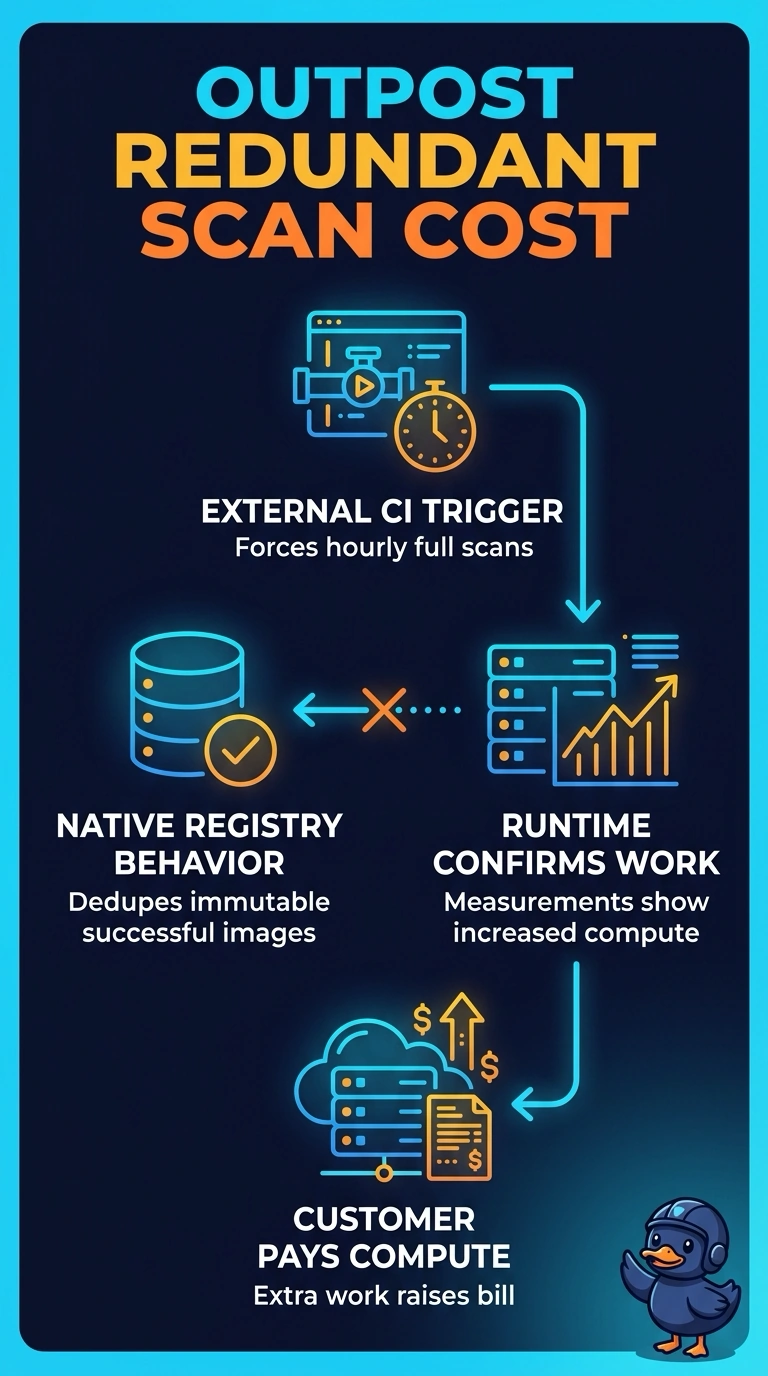
An external CI workflow on customer-paid outpost infrastructure forces redundant full image-scan work hourly instead of daily; runtime measurements confirm the increased work and charges. Which change explains the jump?
Select an answer to reveal the explanation.
Short Explanation
You’ve confirmed redundant hourly scans on your customer-paid outpost, so that measured extra compute explains the higher charges. Native registry scanning deduplicates successful immutable images and refreshes threat metadata without rereading layers, so attribute cost to observed work—not the schedule change alone. Runtime is the key check.
Full Explanation
Outpost infrastructure is customer-paid, so confirmed extra work directly explains higher charges. Runtime measurements show that the external CI workflow forces redundant full image scans hourly instead of daily, and that observed increase consumes more customer-paid compute. Native registry scanning deduplicates successful immutable images and reevaluates threat metadata without rereading layers; attribute cost to observed extra work, engine updates, failures, or external repeated scan jobs, not the schedule change alone. A Broker VM added in the application subnet provides connectivity plumbing and does not create hourly full image-scan load. Verdict lookups using the region closest to each endpoint describe normal agent routing for verdicts, not outpost image-scan execution, so changing the verdict path does not produce measured redundant scan runtime. The platform asset-group ceiling is 5000 groups and governs inventory grouping, not scanner compute, so raising it cannot explain confirmed scan work. One caveat: a schedule change alone does not establish increased charges; the measured redundant work does. As a practical check, compare scanner runtime and image-scan counts before and after the CI change to tie billing to observed work.