
DSPM is running as cloud scan, and finance expected no related cloud cost at all. No scanner instances appeared, but the company's own log storage grew. How should that bill be explained?
Select an answer to reveal the explanation.
Short Explanation
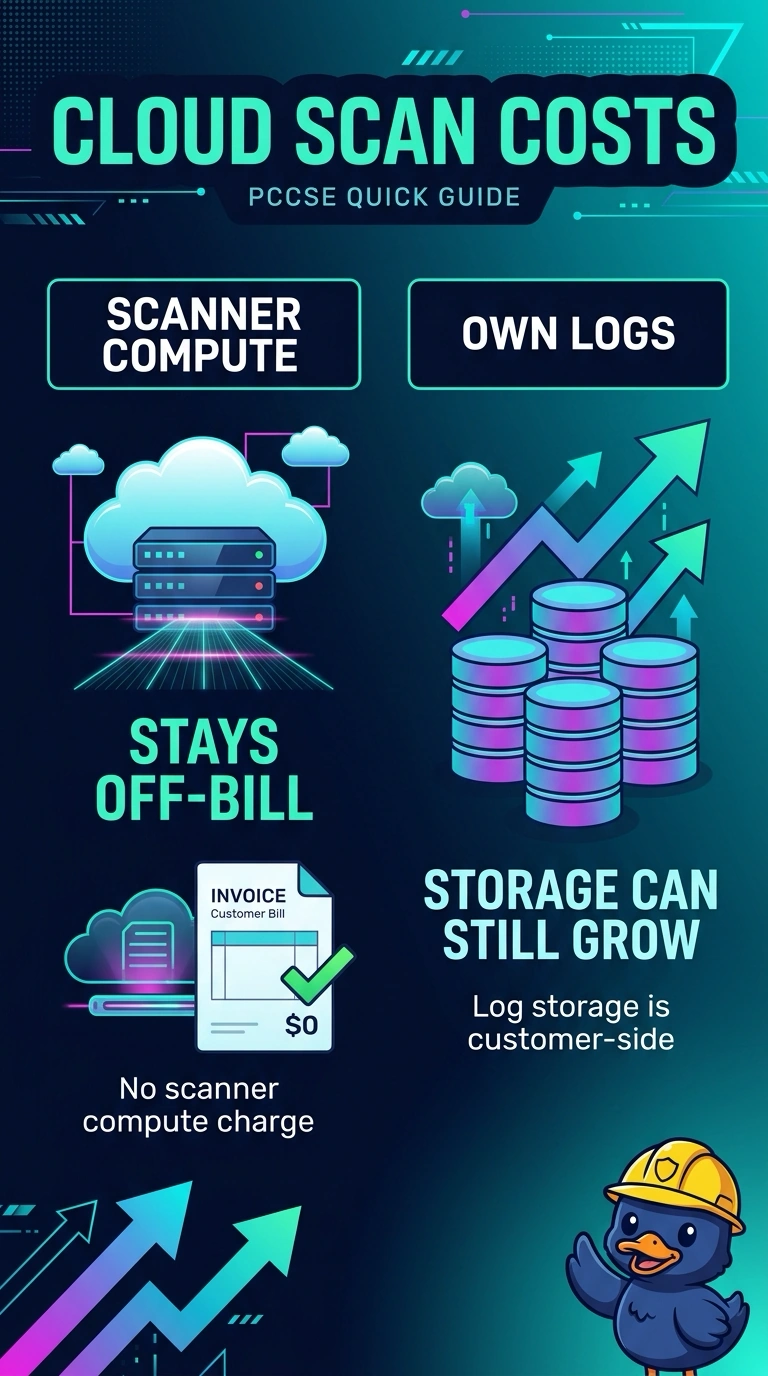
The utility carrying the heavy equipment does not mean your own shed costs nothing to light. Cloud-scan scanner compute stays with Palo Alto Networks, so you should not see a scanner fleet, and your own log storage can still grow. The trap is telling finance that cloud scan leaves a lasting copy of the files on your account.
Full Explanation
Cloud-scan compute is mostly Palo Alto Networks' bill, and a cloud-scan tenant should not show a new scanner fleet on the customer bill. DSPM on cloud scan can read customer data inside Palo Alto Networks accounts and deletes it after the scan. No scanner instances on the customer bill matches that mode. The company's own log storage is still the customer's cost, which is why that line can grow while the scanner fleet does not appear. A lasting copy of scanned files in the customer account is the wrong description of cloud-scan DSPM, and a customer-billed fleet would mean an outpost or some other workload. The Broker VM is not the DSPM scanner. Office 365 DSPM is a SaaS data source on cloud scan, not a Broker VM function. An outpost is not required for cloud-scan DSPM. SaaS DSPM for Office 365 and Snowflake is cloud scan only, and an outpost-only design would miss that requirement. Exam caveat: duplicate audit pipelines can still raise ingestion cost on a cloud-scan tenant, and that cost is not a scanner fleet either. Operational check: show finance the absence of scanner instances, identify the log-storage growth as the customer's own pipeline, and confirm DSPM findings exist without a copy of the file contents left in the customer account.