
Veracode SARIF uploads succeed, and the ingested findings are visible in Cortex. The unified application policy never raises those findings during CI. What limitation must the engineer account for?
Select an answer to reveal the explanation.
Short Explanation
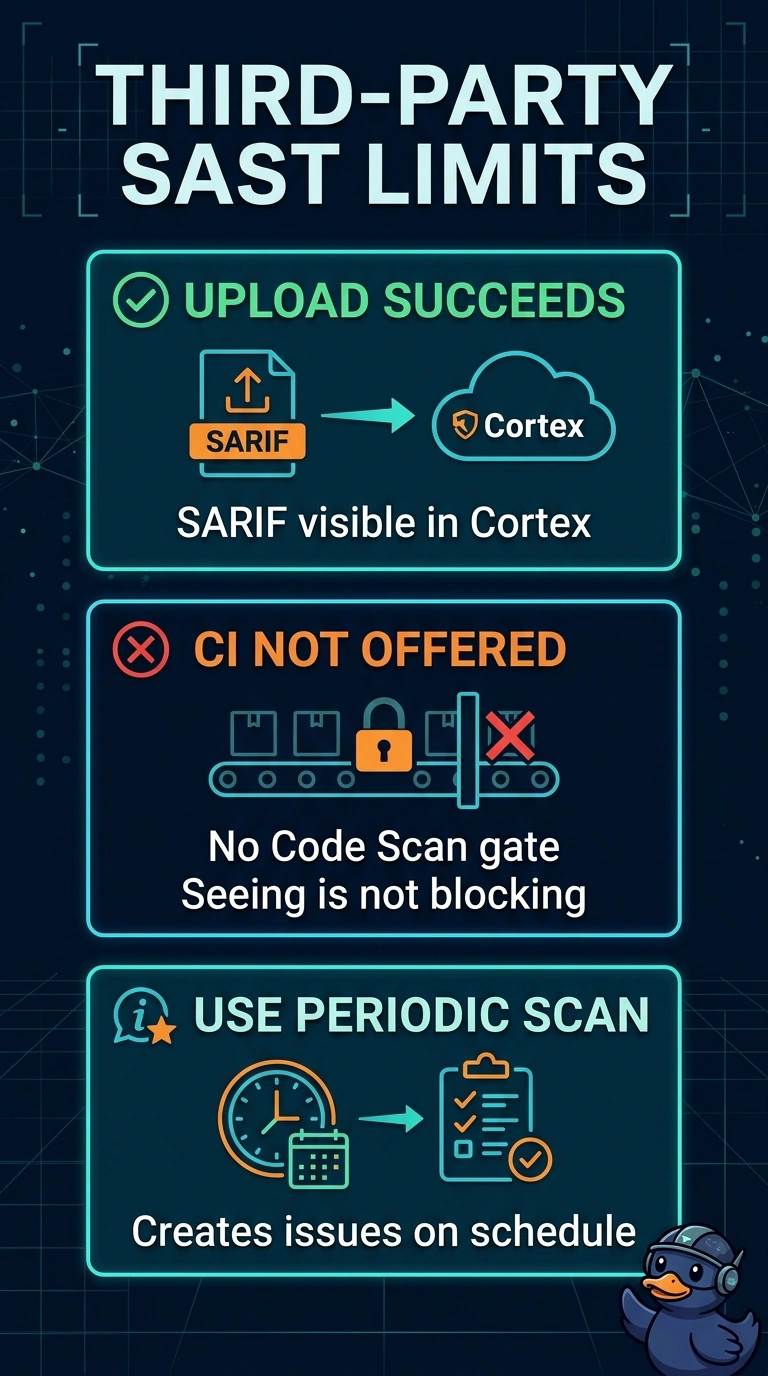
You already did the upload right — you can see the Veracode findings. You must use the supported Periodic Scan trigger to create issues because ingested third-party SAST findings do not support CI blocking.
Full Explanation
Veracode/generic SAST ingestion supports issue creation through periodic evaluation. Third-party code weaknesses are not offered for CI Code Scan/PR/IDE enforcement. Visibility does not make them a CLI gate. That is why the unified policy never raises the Veracode feed during CI despite successful upload and visibility in Cortex. The supported path is a Periodic Scan trigger that evaluates the ingested third-party weaknesses and creates issues on schedule, not a code-scan gate in the build. The upload-step theory fails because successful SARIF ingestion and visible findings already prove delivery; re-adding upload cannot add a CI enforcement capability that the platform does not offer for this source. The Semgrep theory fails because Veracode SARIF is accepted as generic third-party SAST and does not require a different scanner job; ASPM ingests and correlates results rather than running Semgrep or Veracode itself. The IDE-trigger theory fails because IDE enforcement is also not offered for ingested third-party code weaknesses, and an editor result cannot become a CI pipeline block. Engineer check: keep SARIF ingestion, configure the Periodic Scan trigger, then verify issues are created from a known Veracode finding.