
Permissive-policy violations fail the pipeline, but violations that exist only on the strict policy still merge. The strict policy's only trigger is IDE Scan, and the permissive policy has the CI trigger. Why does CI ignore the strict rules?
Select an answer to reveal the explanation.
Short Explanation
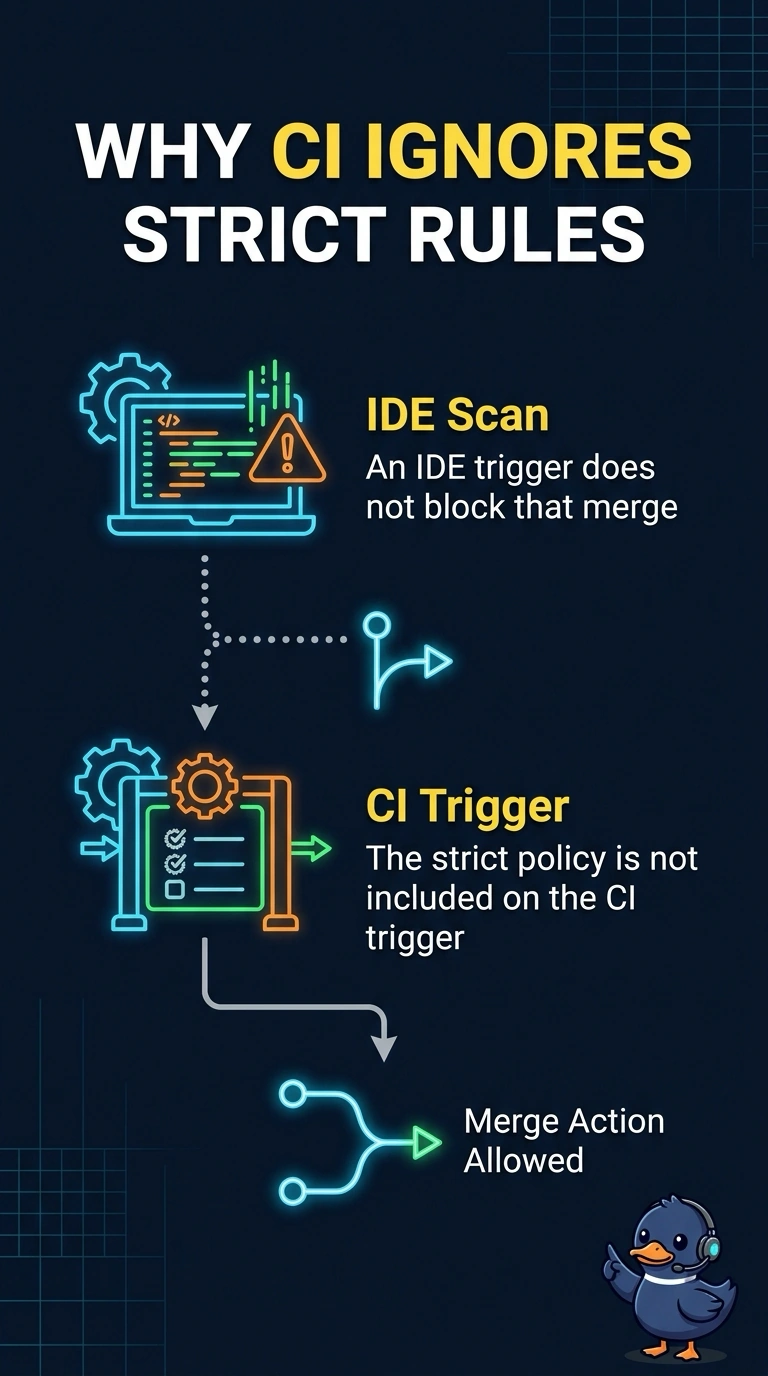
You’ve got the key distinction: CI runs the permissive policy, while the strict policy is set to run only in the IDE. Because an IDE trigger doesn’t block a merge, the strict rules never reach CI; the issue is the trigger, not the exit status or output format.
Full Explanation
Pull-request blocking happens in the platform pull-request scan, while an IDE Scan trigger reports in the editor. The permissive policy has the CI trigger, so its violations fail the pipeline. The strict policy’s only trigger is IDE Scan, so its rules never run in CI and cannot block the merge. If the runner ignored the CLI exit status, permissive violations would also fail to stop the job; the stem says they do, so the exit status is being honored for the policy that runs. Blocking is not performed in the editor: a highlight from the strict policy does not fail the pull request. JUnit XML is a Code Security output format that the CLI can emit, but it does not put an IDE-only policy on the CI trigger. Exam caveat: installing cortexcli does not enable a trigger that is absent, so adding the binary without adding the strict policy to the CI trigger leaves the same gap. Practical check: open both policies, confirm only the permissive policy lists the CI trigger, add that trigger to the strict policy if merges must enforce it, and rerun a pull request that violates a strict rule.