
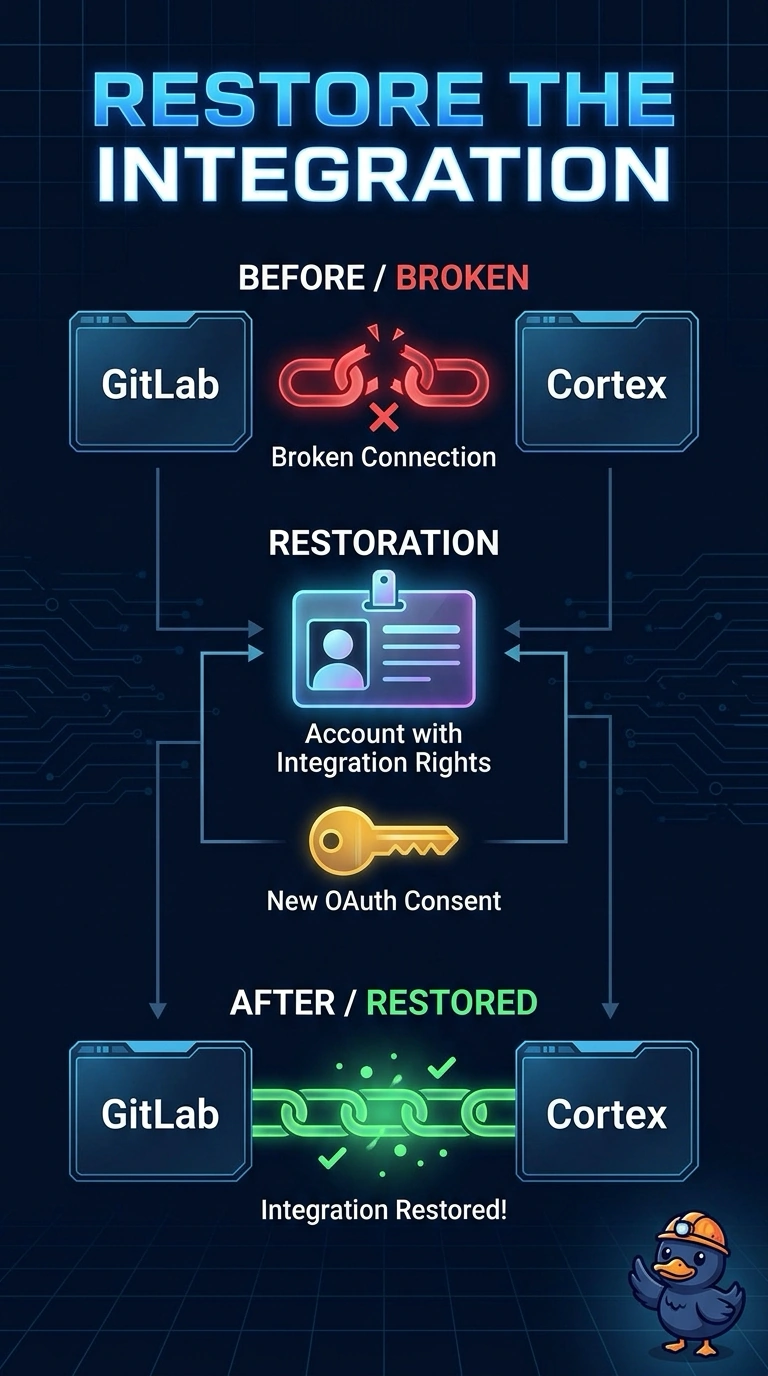
GitLab pipeline events stopped after the employee who granted OAuth consent left and that account was disabled. Other admins can still open the Cortex console. What restores the integration?
Select an answer to reveal the explanation.
Short Explanation
Think of OAuth consent as a signature on a permission slip from a person who no longer works here. You can still walk into the Cortex lobby, and GitLab will not honor that old signature. A new consent has to come from an account that still exists.
Full Explanation
Development-system integrations use OAuth or a personal access token, plus webhooks. When the account that granted OAuth consent is disabled, GitLab stops honoring that grant and pipeline events stop. Restore it with a new OAuth consent from an account that still exists and that holds the rights the integration requires. A browser login to Cortex by a remaining administrator proves console access only. A successful console login does not prove the machine credential or the OAuth grant still works. Changing how long audit logs are kept is a cloud-ingestion planning choice, not the GitLab credential, and it does not restart webhook delivery. A static asset group is a hand-picked inventory list. It cannot be an access scope, and listing the departed user in one does not renew OAuth consent on GitLab. Exam caveat: an expired OAuth grant fails the same way even when the person is still employed. Check the grant and the account state, not only the employee directory. Operational check: have a current GitLab admin complete consent, send a pipeline event, and confirm Cortex receives it while the disabled account stays disabled.