
Image scans from an AWS outpost became unreliable after the application team launched a production VPC and several services in that same account. What deployment rule did that change break?
Select an answer to reveal the explanation.
Short Explanation
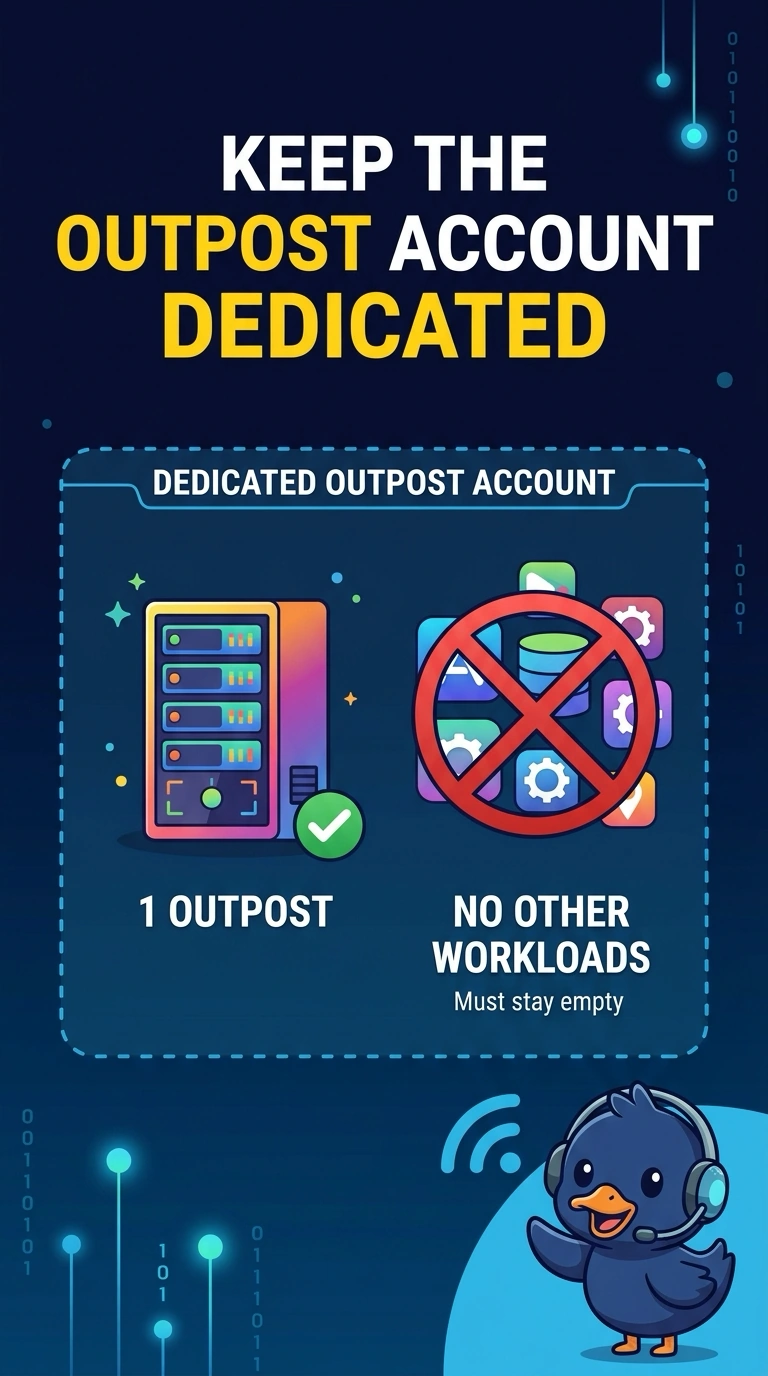
Think of the outpost account as a locked workshop that was never meant to double as the factory floor. You moved production workloads into the account that should hold only the outpost. That account has to stay dedicated and empty of other workloads.
Full Explanation
An outpost lives in a dedicated account with no other workloads. There is one outpost per AWS account, and that outpost is bound to one Cortex tenant. Launching a production VPC and application services in the outpost account breaks the dedicated-account rule and violates the isolation design; inspect quotas, resource contention and errors before assigning the reliability failure to that change. Putting scanners in the application VPC so they can reach Cortex directly reverses the design. Scanner virtual machines stay in private subnets in the dedicated account and must not share the application VPC. Several outposts in one AWS account, even with different VPC tags, violates the one-outpost-per-account rule. Tags do not create an extra outpost slot. Requiring cloud scan and the outpost to share the application account mixes the two scan modes. Cloud scan is Palo Alto Networks running the scanners. An outpost is the customer-owned deployment in its own account, not a guest inside the application account. Exam caveat: Azure uses a subscription and GCP uses a project for the same one-outpost boundary. The dedicated-and-empty rule is the same idea on those clouds. Operational check: inventory the outpost account for workloads that are not part of the outpost, and move that production VPC out before you tune scanner routes.