
Two Cortex tenants were both pointed at the same AWS outpost. Registration for the second tenant does not stay attached. What binding does that outpost enforce?
Select an answer to reveal the explanation.
Short Explanation
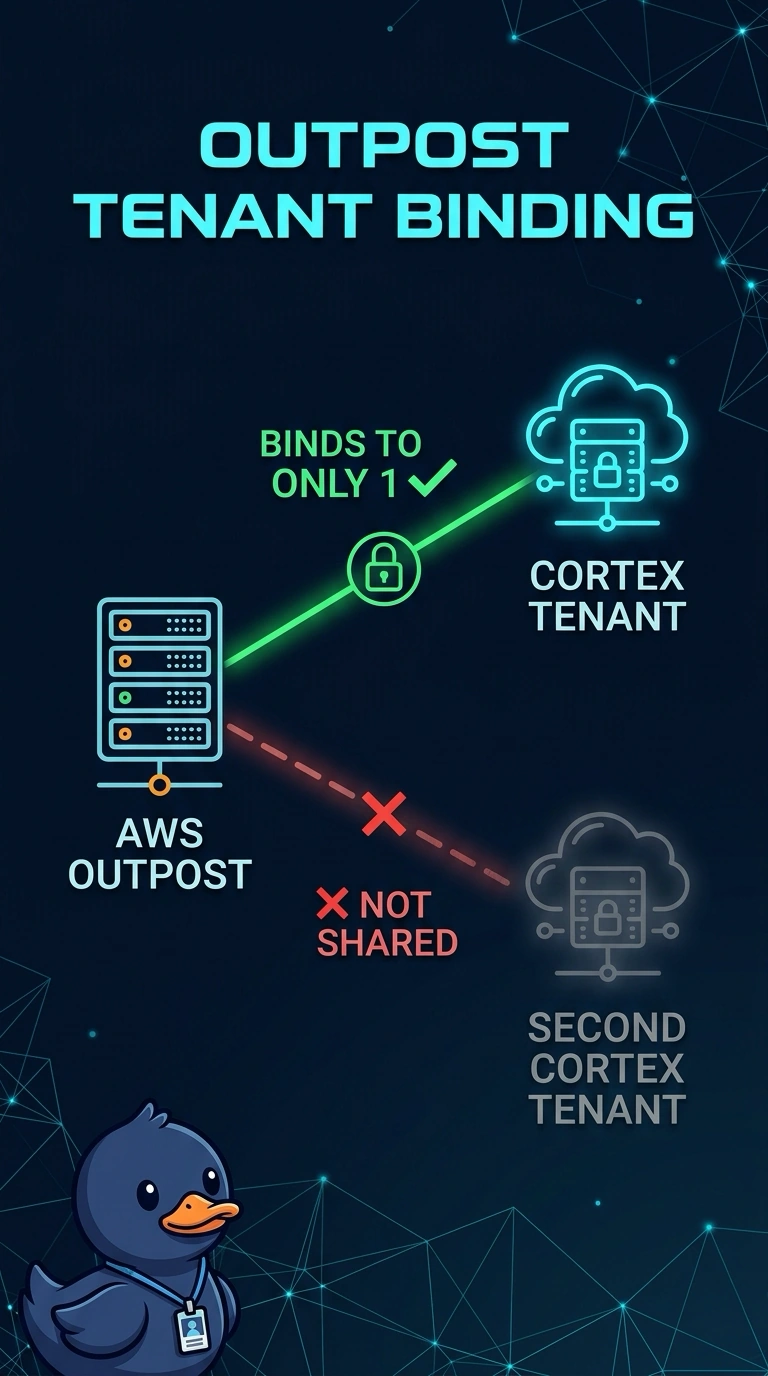
Think of the outpost as a phone registered to one household. You cannot put the same handset on two Cortex tenants and expect both lines to stay connected. The second tenant drops because an outpost binds to a single tenant.
Full Explanation
An outpost is bound to one Cortex tenant. Pointing a second tenant at the same AWS outpost violates that binding, so the second registration does not stay attached. The fix is a design correction, not a second approval click on the same stack. An outpost does not bind itself to every tenant in the customer organization. One account, one outpost, one tenant is the boundary. Binding to the Broker VM and ignoring the tenant confuses the broker with the outpost. The broker bridges a customer network for endpoint routing, log collection, and file forwarding. It is not the object that holds the outpost registration. Waiting for both tenants to approve the same stack in the application account adds a workflow the product does not use, and it also puts the outpost in an application account instead of a dedicated account. Approval from a second tenant cannot create a second binding on one outpost. Exam caveat: a standard outpost moves from Pending to Connected after the registration callback. Pending on the first tenant means that callback has not succeeded, which is a different fault from a second tenant that is not allowed to attach. Operational check: record which tenant the outpost is bound to, and give the other tenant its own outpost in its own dedicated account if that tenant truly needs one.