
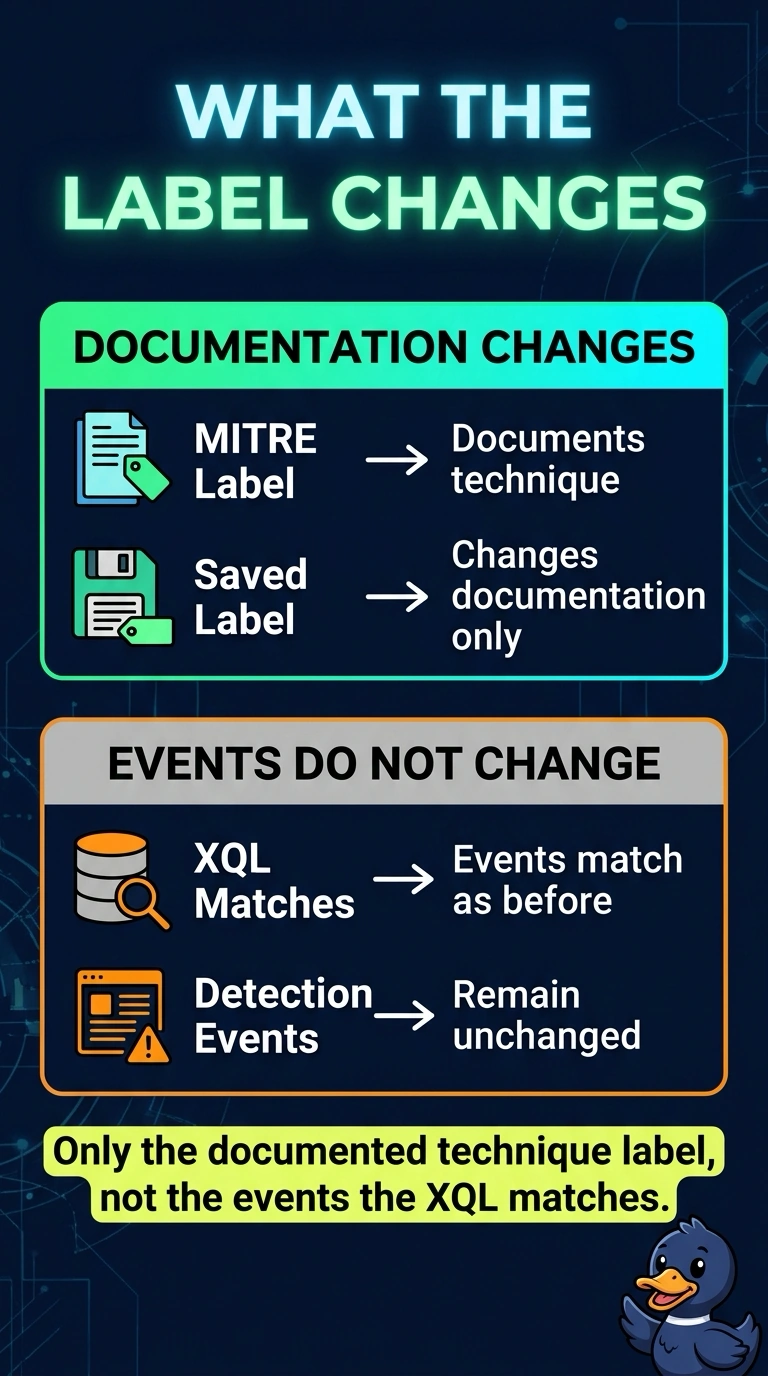
A BIOC is given a MITRE technique label so the SOC can document the detection. After the label is saved, the same events match as before. What did that label change?
Select an answer to reveal the explanation.
Short Explanation
You can think of the MITRE technique label as a tab on a folder: it helps you document what the detection represents, but it doesn’t change the papers inside. Since the BIOC’s XQL still selects the same events, adding the label leaves its matches unchanged. The label doesn’t rewrite the event_type condition, change prevention profiles across endpoint groups, or move a vulnerability finding to the top of the policy order.
Full Explanation
A BIOC matches events according to its XQL, which must include the required event_type condition. A MITRE technique label documents the detection for the SOC; saving it does not change which events the XQL selects, so the same events continue to match. Editing the XQL filter, including its event_type condition, could change the matches, but that is not what adding a documentation label does. A prevention profile is assigned through endpoint groups and governs whether activity is blocked or reported on a host; the label neither changes that profile across endpoint groups nor rewrites the BIOC’s XQL. Vulnerability policy order applies to vulnerability findings, with policies evaluated from top to bottom; it does not move a BIOC finding to the top row. Exam caveat: analytics that use asset roles as context are separate from this BIOC, and a role can affect an analytics score without editing the BIOC’s XQL. Practical check: compare the XQL before and after saving the label, confirm the event_type condition is unchanged, and verify that a historical replay returns the same matches.