
A detection should fire when one virtual-machine process starts a script that then launches a second unsigned binary. The chain is a single behavior on endpoint data. Which rule type fits?
Select an answer to reveal the explanation.
Short Explanation
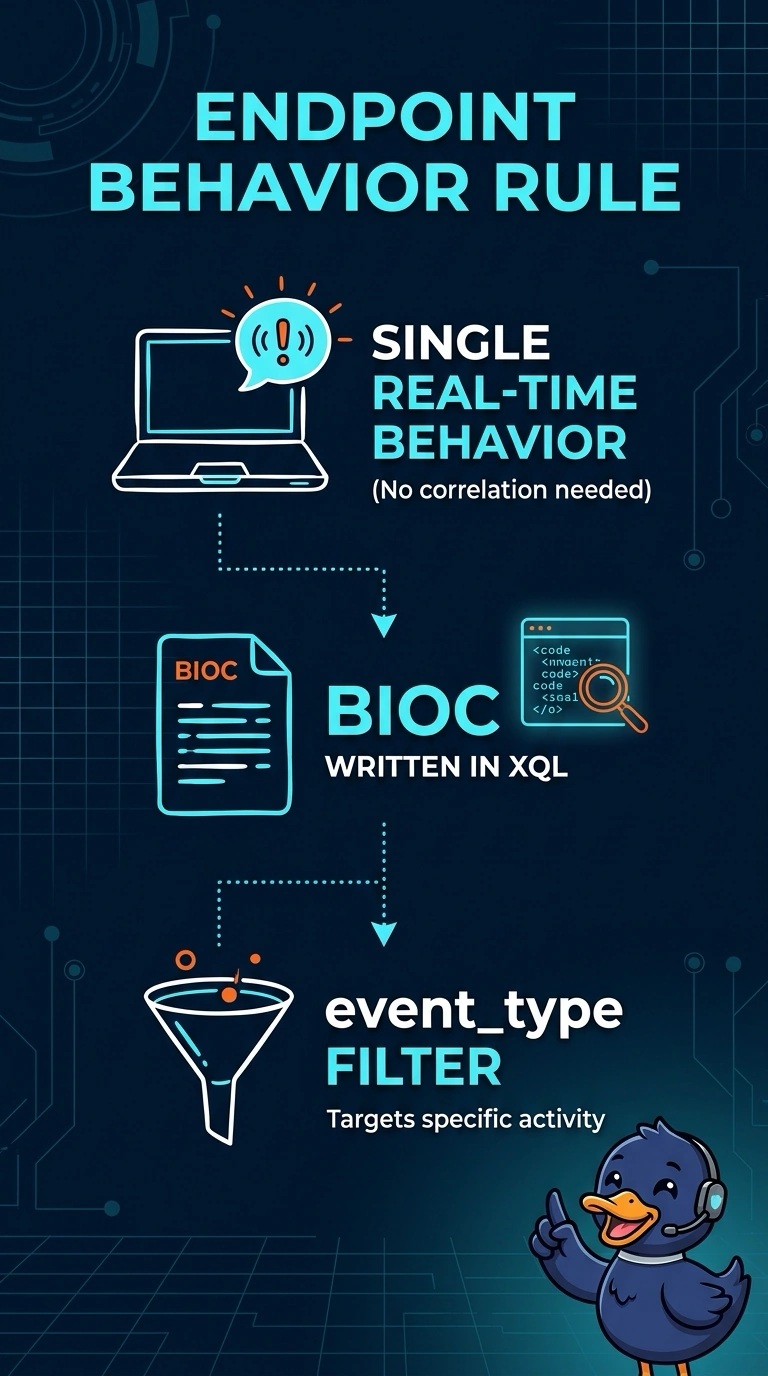
You are watching one motion, a process handing work to a script that starts another binary, not three unrelated alarms. A BIOC in XQL that filters event_type is the real-time behavior rule for that chain. The trap is building a correlation, or an indicator for a hash you were never given.
Full Explanation
A BIOC is a real-time behavior on endpoint data, or on supported cloud-audit data, and it must filter event_type. Custom detections of this kind are XQL. One process chain on a virtual machine is a single behavior, so a correlation is unnecessary. An IOC matches a known hash, address, domain, or path. The stem describes a chain of process activity, not a known hash, so an indicator for the parent hash would miss the behavior and invent an indicator the case did not provide. A Scheduled correlation can use joins and windows; real-time correlation supports a restricted set of XQL stages and does not support arbitrary joins that can run as often as every 10 minutes. Joining three sources every 10 minutes answers a different question from one endpoint behavior. Analytics use asset roles as context. They are not a hand-written behavior rule, and adding a role does not define this process chain. Exam caveat: validate the BIOC on history and keep it disabled until it is tuned, so a broad event_type filter does not page on benign process trees. Operational check: replay a known-good and a known-bad process chain from endpoint data, confirm the BIOC filters event_type, and confirm it matches the bad chain without a second data source.