
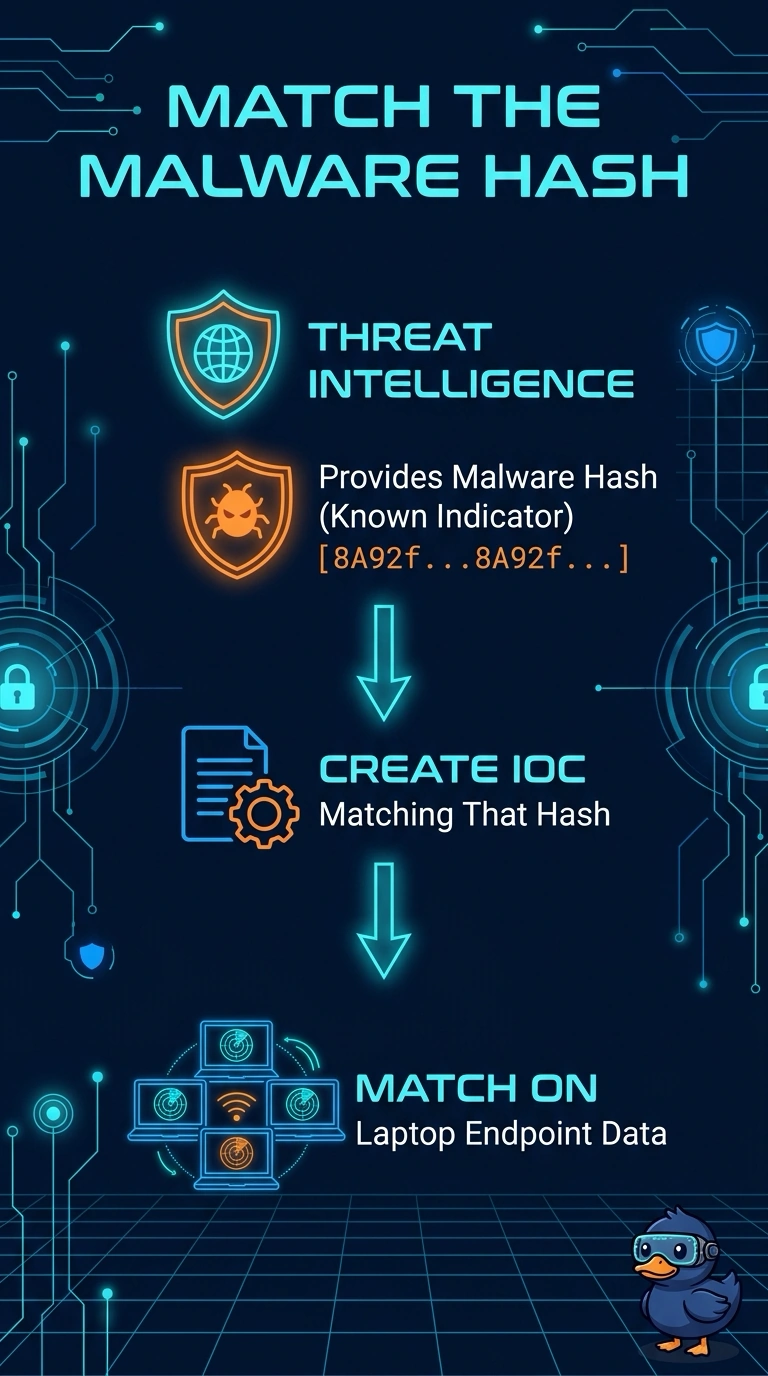
Threat intelligence supplies one malware hash already seen on laptops. The detection should match that hash on endpoint data. Which rule should the engineer create?
Select an answer to reveal the explanation.
Short Explanation
You already have a known hash, so an IOC on endpoint data is the direct match. You can keep this simple: the hash does not need to become a process chain or wait for a cloud-audit join. This gives you a focused detection on the laptops.
Full Explanation
An IOC matches a known hash, address, domain, or path on endpoint data. Threat intelligence has already supplied this malware hash, and the detection needs to match it on the laptops, so an IOC is the direct fit. A BIOC represents behavior in real time and filters on event_type; turning this known hash into a multi-step process chain describes activity the intelligence did not provide and is unnecessary for a simple indicator match. A correlation can join sources or use a time window, and it can run on a schedule as often as every 10 minutes. Requiring a cloud-audit event before the hash can match adds a source and delay when endpoint indicator data can match it alone. An analytics rule can use an asset role as context, but setting a role requirement without storing the hash as an indicator does not create the needed hash match. Exam caveat: an IOC detects the indicator but does not remediate the host; a playbook handles response, not the detection rule itself. Practical check: search recent endpoint data for the hash, confirm the IOC matches that value, and verify that a laptop with a different hash does not match.