
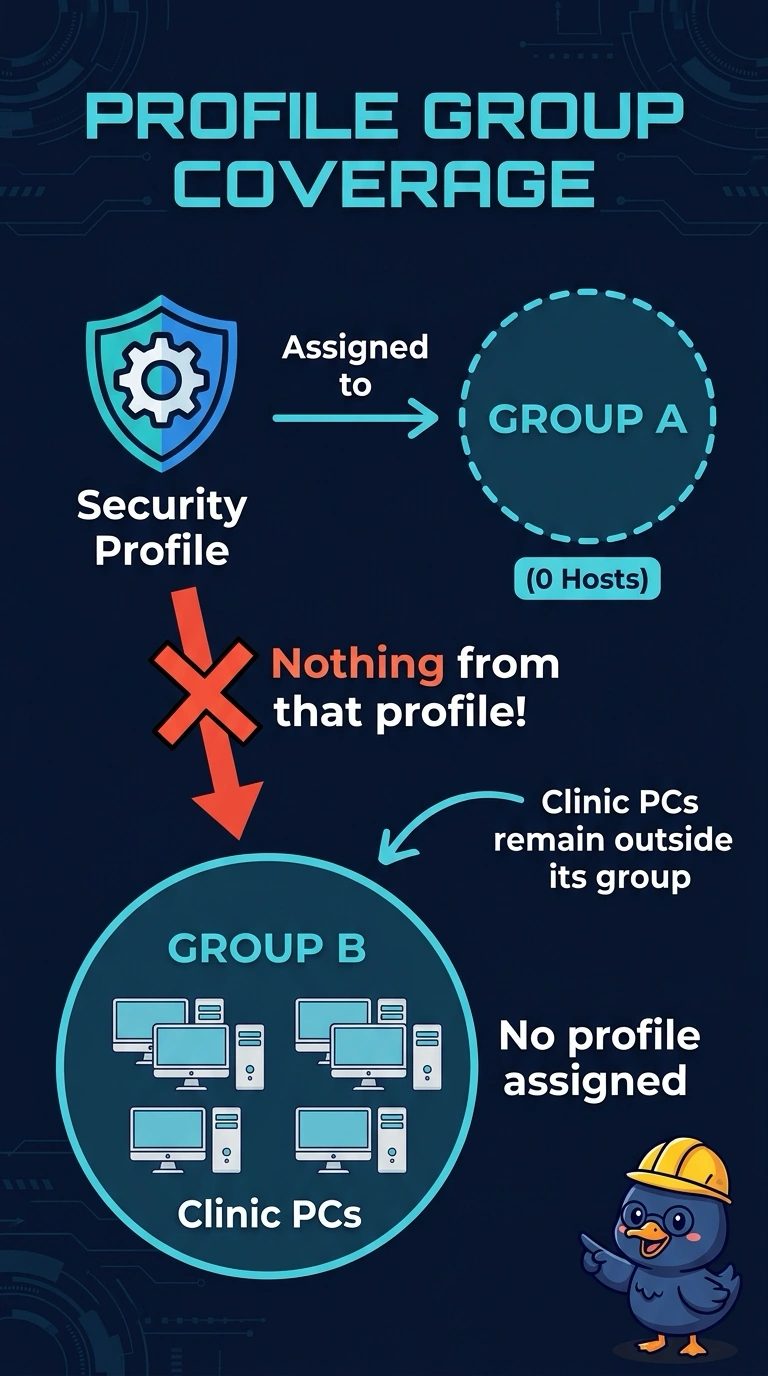
A ransomware prevention profile is tuned carefully and assigned to an endpoint group that contains no hosts. Veterinary-clinic PCs sit outside the custom policy targeting the tuned profile. Other applicable or default malware profiles can still protect these PCs; unassigned custom profiles do not prove total absence of prevention. What protects those clinic PCs?
Select an answer to reveal the explanation.
Short Explanation
Think of a perfect lock installed on a door nobody uses. You tuned a prevention profile in a custom policy rule that does not target the clinic PCs, so you get nothing from that tuned profile on those hosts. Other applicable or default malware profiles can still protect these PCs; unassigned custom profiles do not prove total absence of prevention.
Full Explanation
Protection applies through a policy rule targeting endpoints/groups, not through the existence of a well-tuned profile alone. The tuned ransomware profile is assigned to a group with no hosts, and the veterinary-clinic PCs sit outside the custom policy targeting the tuned profile, so nothing from that tuned profile protects them. Other applicable or default malware profiles can still protect these PCs; unassigned custom profiles do not prove total absence of prevention. Claiming the empty group still covers every agent treats groups as labels instead of the assignment mechanism that links a profile to targeted endpoints. An agentless disk scan of the clinic golden image inspects files at rest on a schedule. It does not enforce a prevention profile and it does not block ransomware execution on a live clinic PC. A Sensitive data-classification profile classifies data that is not PCI, PHI, PII, financial, or developer secrets. It does not prevent a malicious process on an endpoint. Operational check: place the clinic PCs in scope of a policy rule that targets them with the prevention profile, then confirm a clinic host reports that profile as assigned.