
A grocery chain's cluster runs the Kubernetes connector. Only the connector Posture Management capability is enabled; Realtime Protection is disabled and no runtime agent is deployed. Which coverage is actually in place?
Select an answer to reveal the explanation.
Short Explanation
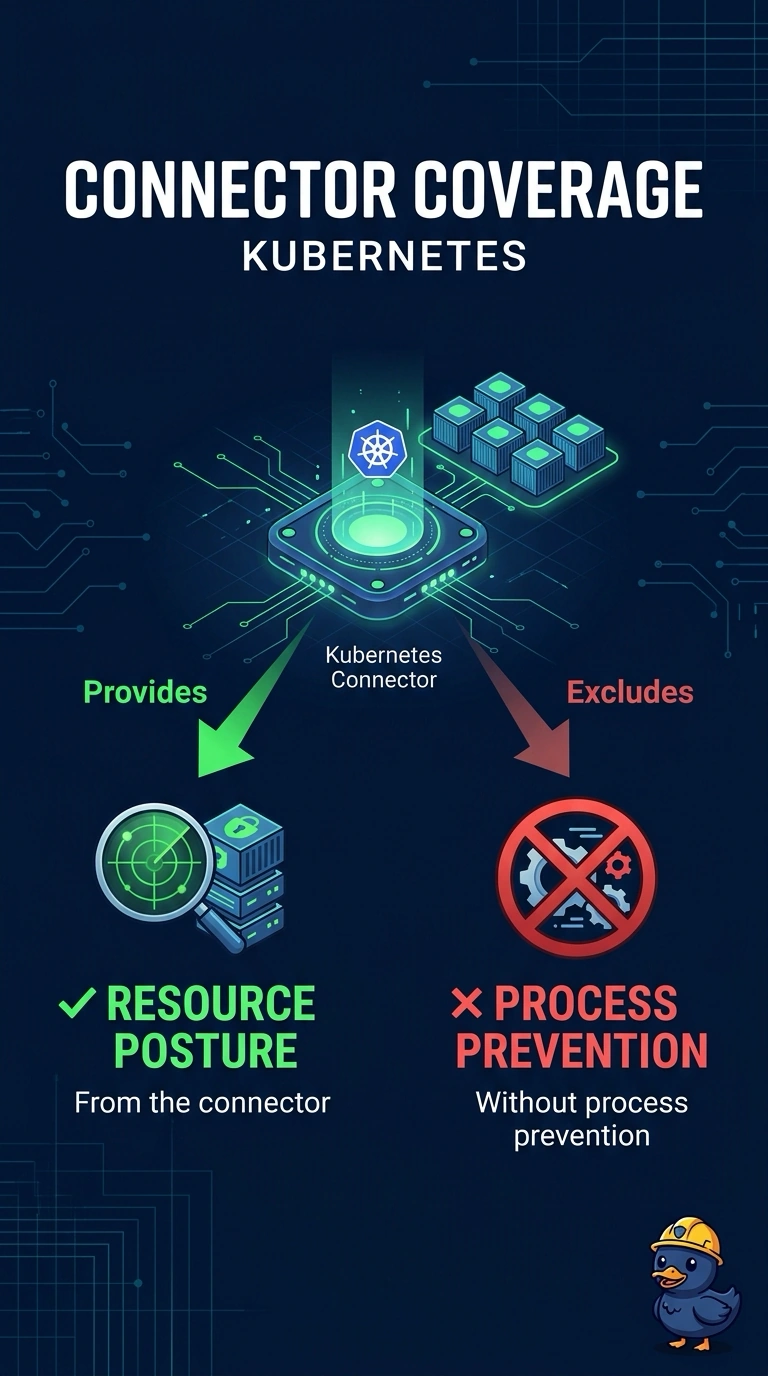
Think of the connector as an inspector who reads the building plans, not a guard who watches the hallway. You have resource posture for the cluster, while process prevention still requires an agent. The trap is treating a connector deployment as runtime security.
Full Explanation
The Kubernetes connector provides a cluster resource feed, and a connector rule can evaluate resource kind, metadata, and spec. That gives you resource posture, not runtime protection. The connector can deploy admission enforcement when enabled, but that is distinct from process telemetry and prevention. A posture-only connector does not provide runtime process protection; without an agent on nodes or workloads, you have neither process telemetry nor process prevention. Process prevention inside every pod cannot be supplied by the connector alone, because a resource feed does not provide that runtime coverage. Broker VM forwarding is not a substitute: a Broker VM bridges endpoint routing, logs, and files, and installing the connector does not deploy one or provide node or workload runtime coverage. Serverless function scanning is a cloud-account capability for functions, not cluster control-plane scanning, and it does not come with the connector. Exam caveat: configured admission policies can block deployment through the admission controller; do not assume this universally requires an XDR agent. Practical check: confirm whether an agent is registered for the grocery chain’s nodes, and treat connector findings as posture until an agent is actually deployed.