
A build utility is blocked on production servers, which is intended, and the same binary must run on build hosts only. How should that allowance be written?
Select an answer to reveal the explanation.
Short Explanation
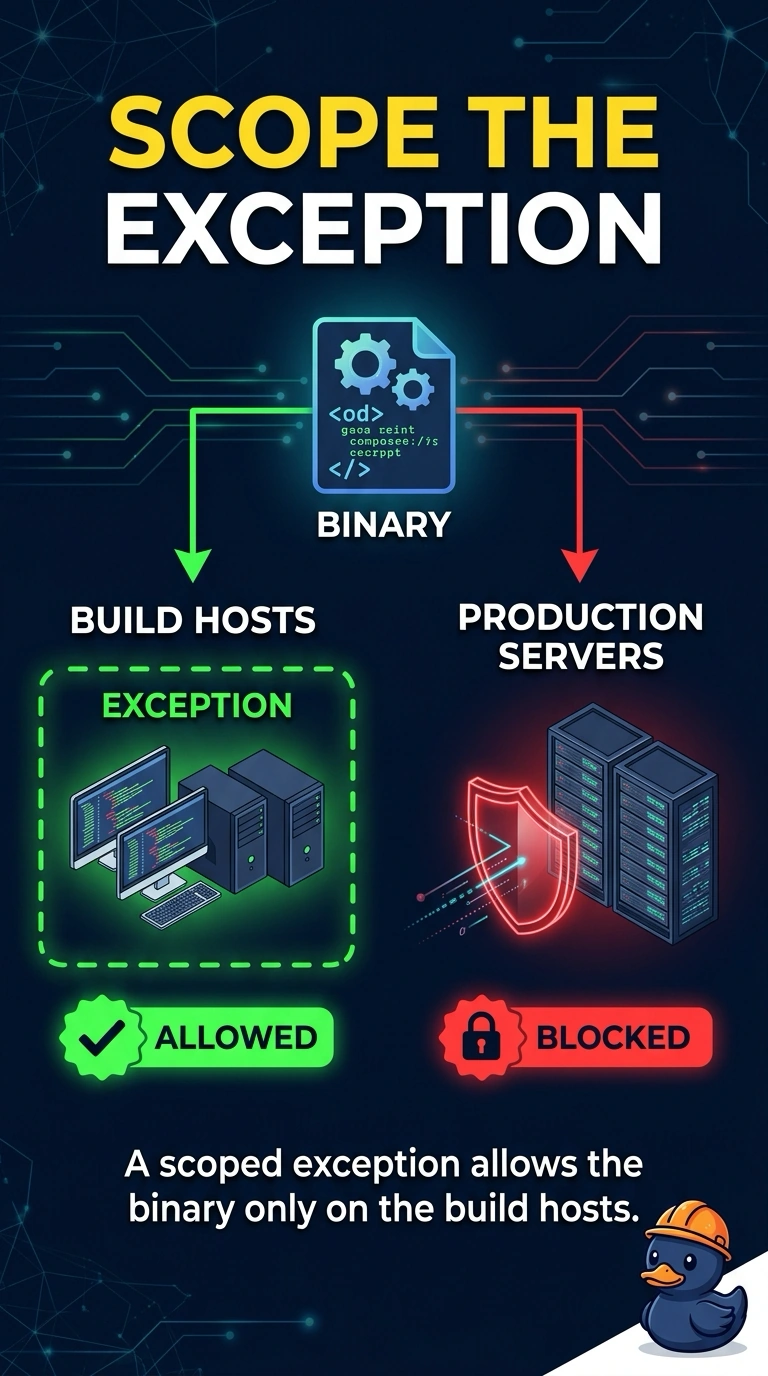
Think of a global exception as propping open every door because one loading dock needs a hand truck. You want the build utility blocked in production and allowed on build hosts, so the exception has to be scoped to those hosts. The trap is lifting the block for the whole tenant.
Full Explanation
Exceptions are scoped. A global exception is broader than a device or group exception and would allow the build utility on production servers as well as build hosts, which undoes the block that is intended. A scoped exception on the build hosts keeps production prevention in place and lets the binary run where it must. An extension profile adds a capability. It does not replace the prevention profile, and swapping it in on every host would remove prevention rather than carve out one binary. A data-classification profile such as Developer Secrets or PII classifies data in stores. It does not allow or block a process hash on an endpoint, so pointing it at object storage does nothing for this utility. Exam caveat: endpoint groups decide which prevention profile applies. The exception should follow the build-host group, not a profile that production also receives. Operational check: confirm the exception scope lists the build hosts only, then verify a production server still blocks the utility while a build host runs it.