
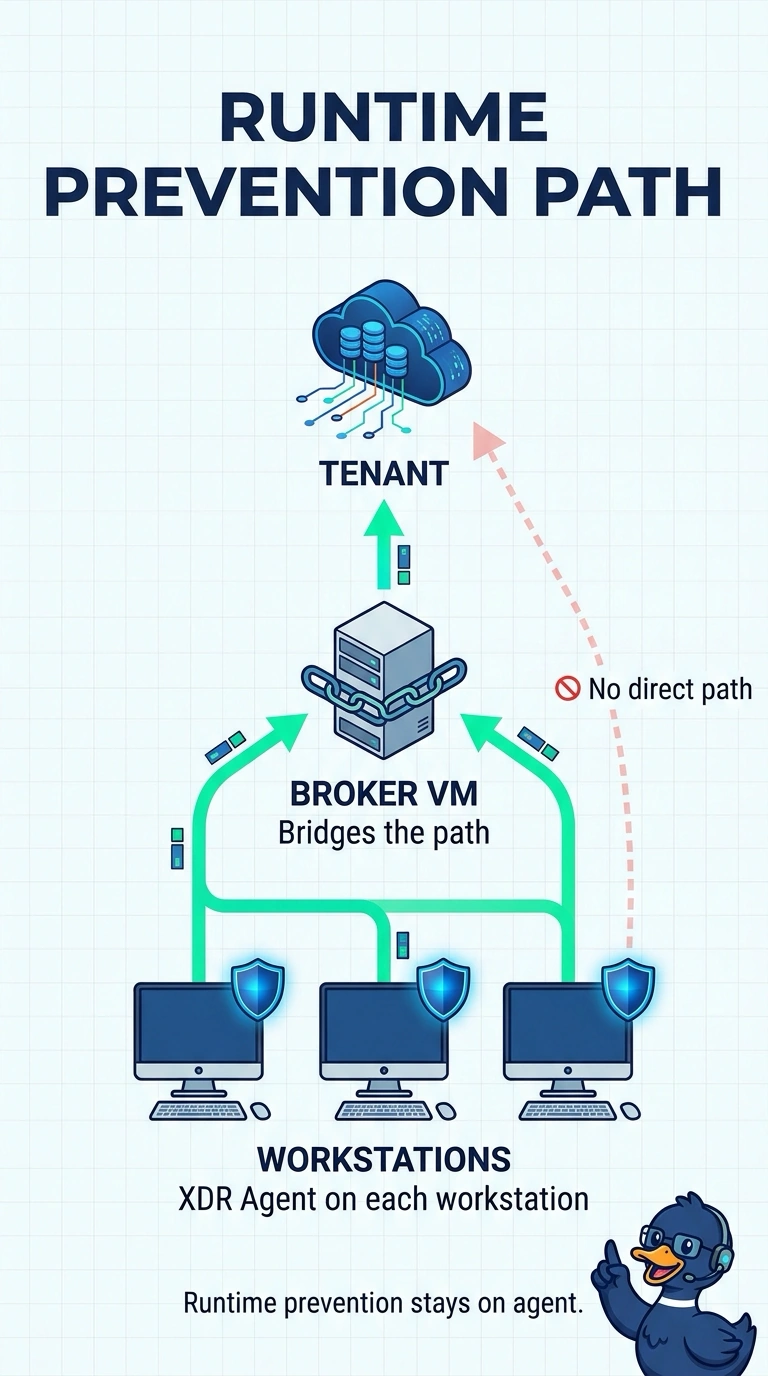
A factory floor has no direct path to Cortex, so workstations will reach the tenant through a Broker VM. What still has to be true for those workstations to get runtime prevention?
Select an answer to reveal the explanation.
Short Explanation
Think of the Broker VM as the ferry, not the passenger: you still need the XDR agent on each factory workstation. The broker only bridges the agent’s path to Cortex, so it cannot provide runtime prevention by itself.
Full Explanation
Runtime prevention on a workstation comes from the XDR agent installed on that endpoint. The Broker VM bridges the factory network to Cortex, allowing the workstation’s agent to communicate even when the workstation has no direct path to the tenant; the broker is a route, not the control that prevents runtime threats. Creating a second Cortex tenant for the factory would split the SOC’s view and would still require an agent on each workstation, so a separate tenant does not provide prevention. Relying on the Broker VM alone fails because it does not replace the endpoint agent; without that agent, the workstation has no endpoint runtime telemetry or prevention. Scheduling an agentless disk scan each night checks disk contents at rest, not live processes, so it cannot provide the requested runtime prevention. Exam caveat: a reachable broker does not mean the endpoints are protected—each workstation still needs its own XDR agent and an applicable prevention policy. Practical check: verify that every factory workstation reports an agent heartbeat through the broker and that the plant’s endpoint group has a prevention profile assigned.