
A campus shuttle app scans its images in a registry and also runs those images as containers as a service. Policy requires runtime prevention on the running service. What is still required?
Select an answer to reveal the explanation.
Short Explanation
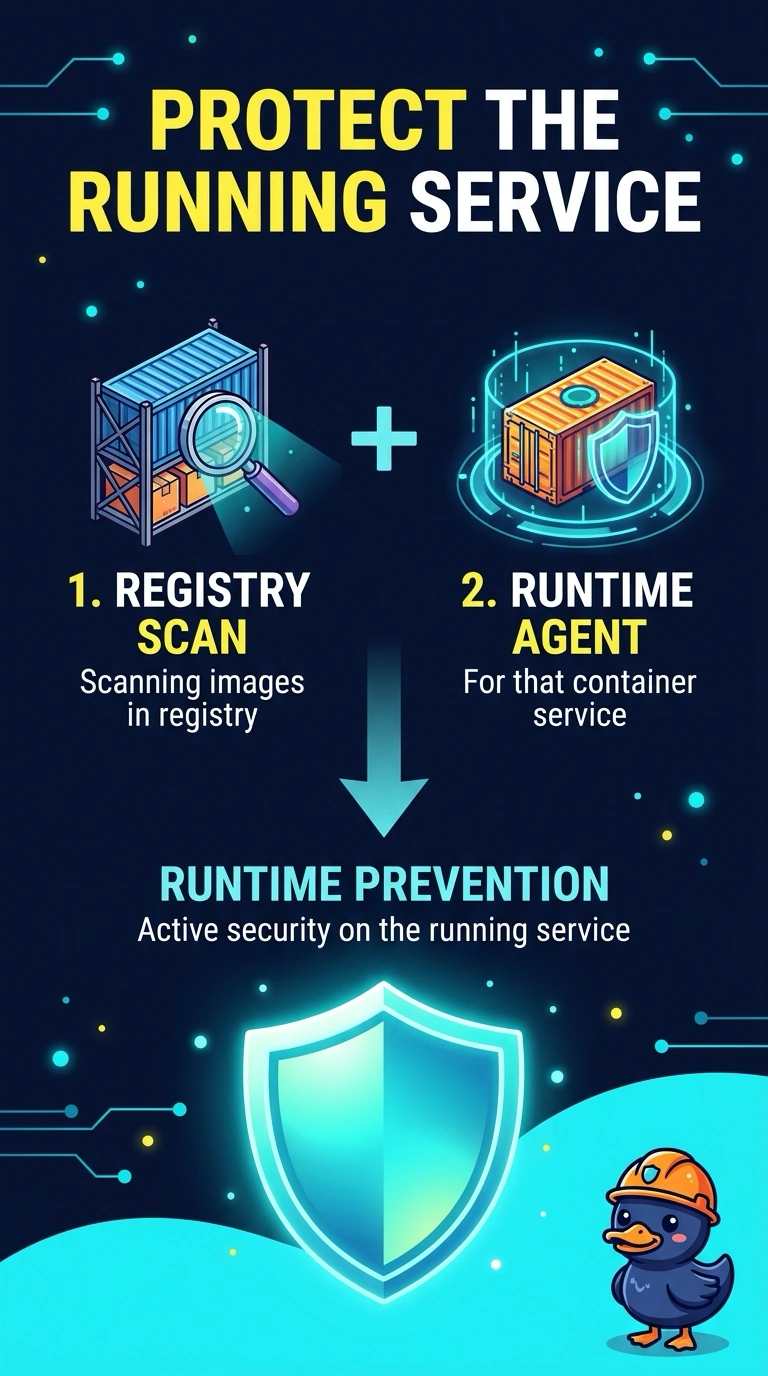
Think of the registry scan as checking the packed lunch, and the agent as the monitor on the bus. You scan the image, but runtime prevention on the running service still needs the runtime agent for that container service. A second registry connection or an outpost scanner virtual machine does not provide that service’s runtime prevention.
Full Explanation
Registry scanning and runtime coverage answer different questions. The registry integration lets workload scanning inspect the image for vulnerabilities, malware, and secrets. Because policy requires prevention on the running container service, the runtime agent for that service is still required in addition to the registry scan. The scan does not become the runtime control, so relying on it alone leaves the running service without the required prevention. A second registry connection only repeats image intake; it does not act as an agent or prevent activity at runtime. An outpost scanner virtual machine scans from the outpost but is not attached to the service as its XDR agent, and it is not the customer’s runtime sensor. Nothing further is therefore insufficient: image scanning and runtime prevention are separate controls, and both can be required. Exam caveat: image findings from a registry scan do not show that runtime prevention is active; the two integrations serve distinct purposes. Practical check: confirm that the registry integration remains in place, that the container-service agent is deployed, and that a prevention profile applies to the running service before considering the policy met.