
A logistics company installed the XDR agent on every EC2 instance and expected Lambda functions in the same account to show agentless function posture/code-scan findings. The functions still have no findings. What was confused?
Select an answer to reveal the explanation.
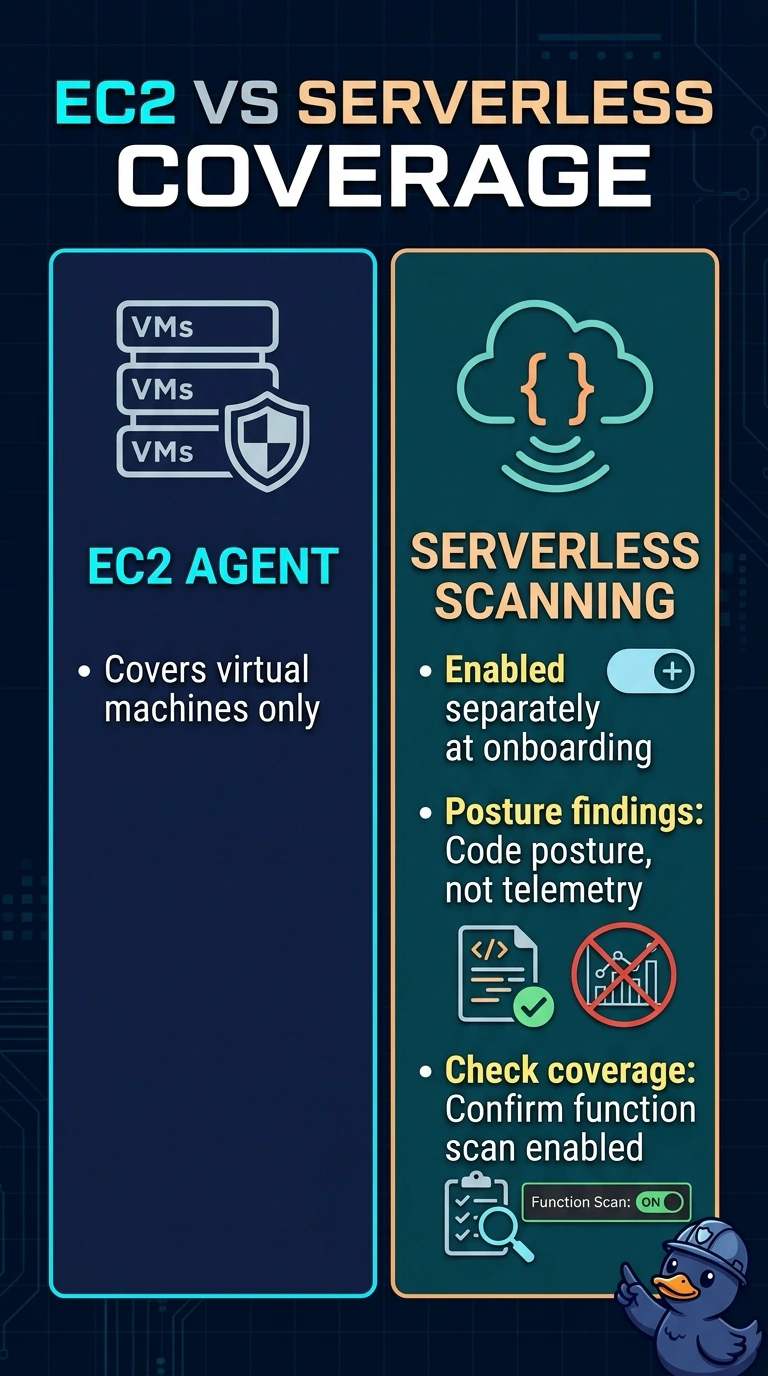
Short Explanation
Think of the EC2 agent as a guard on the warehouse floor, not a stamp on every parcel that leaves the building. You covered virtual machines, but your Lambda posture findings need the separately enabled serverless scanning. Don't let one install trick you into expecting both kinds of coverage.
Full Explanation
The XDR agent covers virtual machines, and installing it on EC2 gives those instances runtime telemetry and prevention when a profile is assigned. Serverless functions are covered through the function integration selected at cloud onboarding. Cloud onboarding can enable supported function scanning; those at-rest findings do not themselves prove invocation-level agent telemetry. The lifetime of an invocation does not make runtime layers/instrumentation impossible. Confusing the two switches leaves Lambda without the coverage the company expected. Agentless disk scan reads image contents at rest. It is not the function integration and it is not live process telemetry on EC2 either. A registry credential in the secret store lets an outpost or integration pull images. It does not install an agent and it does not enable function scanning. Office 365 classification is a SaaS DSPM concern, and cloud audit analytics is a separate onboarding capability. Neither one enables serverless posture scanning for a Lambda function. Exam caveat: agentless scanning and the XDR agent can both be in the design, and you still pick the one that can see the artifact in question. Operational check: confirm serverless scanning is enabled on the logistics account and stop using the EC2 agent inventory as the proof that functions are covered.