
An online retailer's autoscaling group launches instances from an image that has no XDR agent. Operators install the agent by hand after each boot. What closes that gap?
Select an answer to reveal the explanation.
Short Explanation
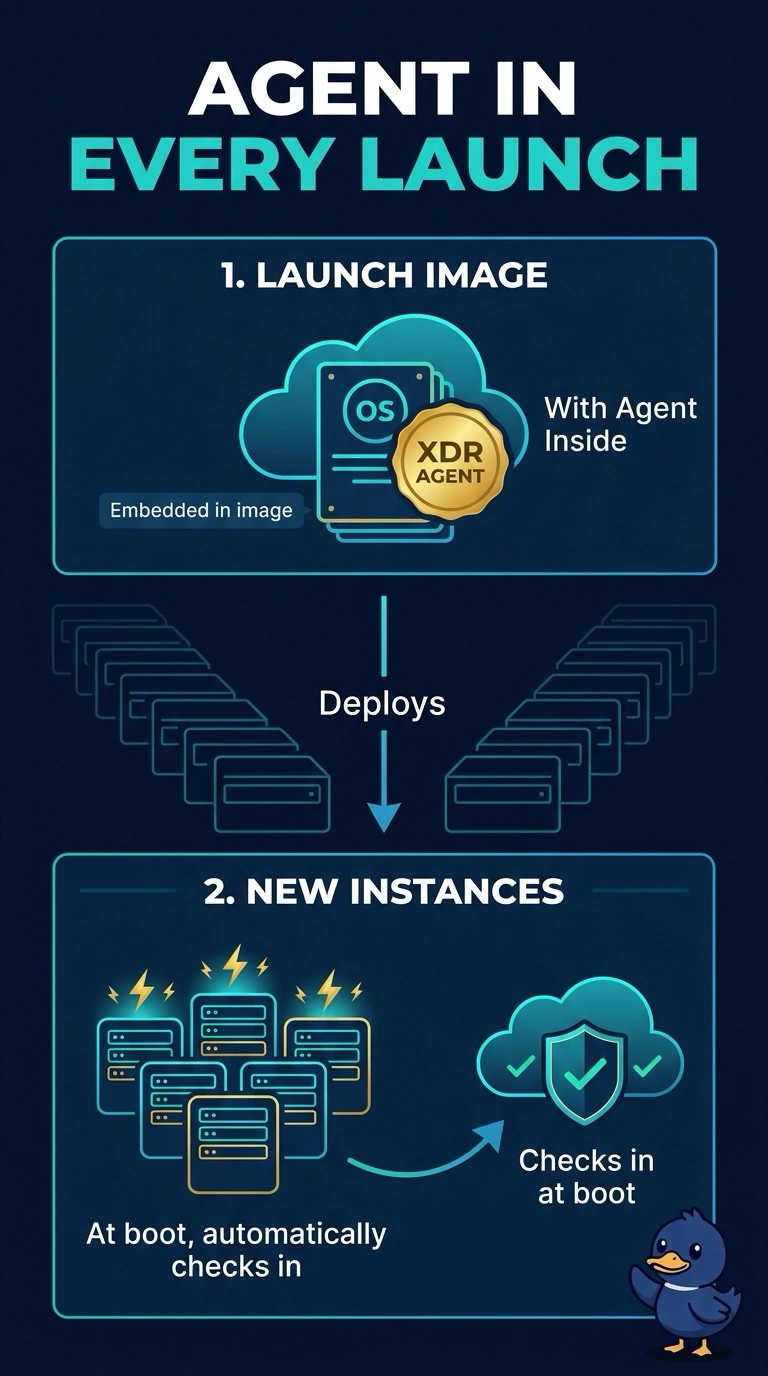
Think of the image as the mold, and a hand install as painting each statue after it leaves the mold. You put the XDR agent in the image so every autoscaled instance checks in at launch. A runbook after boot leaves a window where the new host is up and unmonitored.
Full Explanation
Virtual machines are covered by the XDR agent on the guest. When instances are launched from an image, the agent has to be in that image, or each new host waits on a person. Placing the agent in the launch image closes the gap, because check-in starts as the instance boots. A runbook that installs the agent after the instance is in service preserves the gap on every scale-out. Agentless disk scan inspects volume contents. It does not report live processes and it does not replace the agent in the image. A registry scan of the image can report vulnerabilities, malware, or secrets in the layers. It does not install an agent on the guest that boots from those layers. Exam caveat: an agent in the image still needs the outbound path on TCP 443 and a prevention profile on an endpoint group before the new host is protected. Operational check: launch one instance from the updated image, confirm it heartbeats without a manual install, and confirm an instance launched from the old image still needs the hand install.