
A mining company wants every production workload to run the XDR agent. Outpost scanner virtual machines appear only while scans run. Where should that agent standard live?
Select an answer to reveal the explanation.
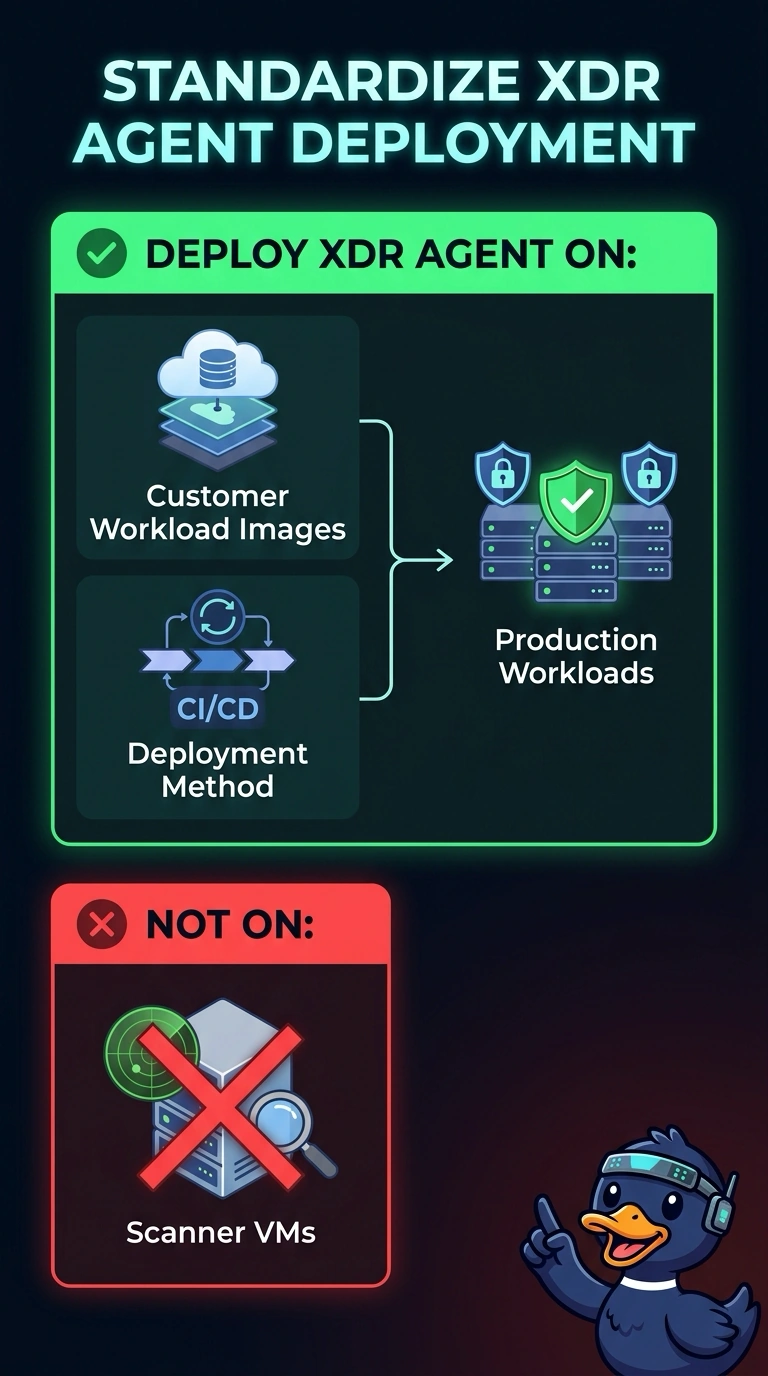
Short Explanation
Think of the scanner virtual machines as rented vans that leave when the delivery is done. You put the XDR agent on your own workload images so production hosts check in. Standardizing the agent on those scanner vans, or on the broker, protects the wrong machines.
Full Explanation
Outpost scanner virtual machines boot from a Cortex-owned image, sit in private subnets, and exist to scan. They are not the mining company's production workloads, and they are the wrong place to standardize the XDR agent. The agent belongs on the customer images and in the deployment method that launches production hosts, so those hosts check in. Putting the agent on the scanner virtual machines customizes a fleet the customer does not keep. Deploy agents through customer workload images and automation; purpose-built outpost scanner VMs are separate scanning infrastructure. The Broker VM is a closed appliance and is not a stand-in for workload agents. A registry credential lets a scanner pull images. It does not install the XDR agent onto a running workload. Verify the effective protection policy; installed agents receive default malware profiles. Operational check: confirm the agent is in the production image or deployment, confirm scanner virtual machines are unchanged Cortex images, and confirm a new production host heartbeats without a manual install.