
A meal-kit company runs Amazon ECS on EC2 container instances and wants runtime telemetry from those services. What deployment matches that model?
Select an answer to reveal the explanation.
Short Explanation
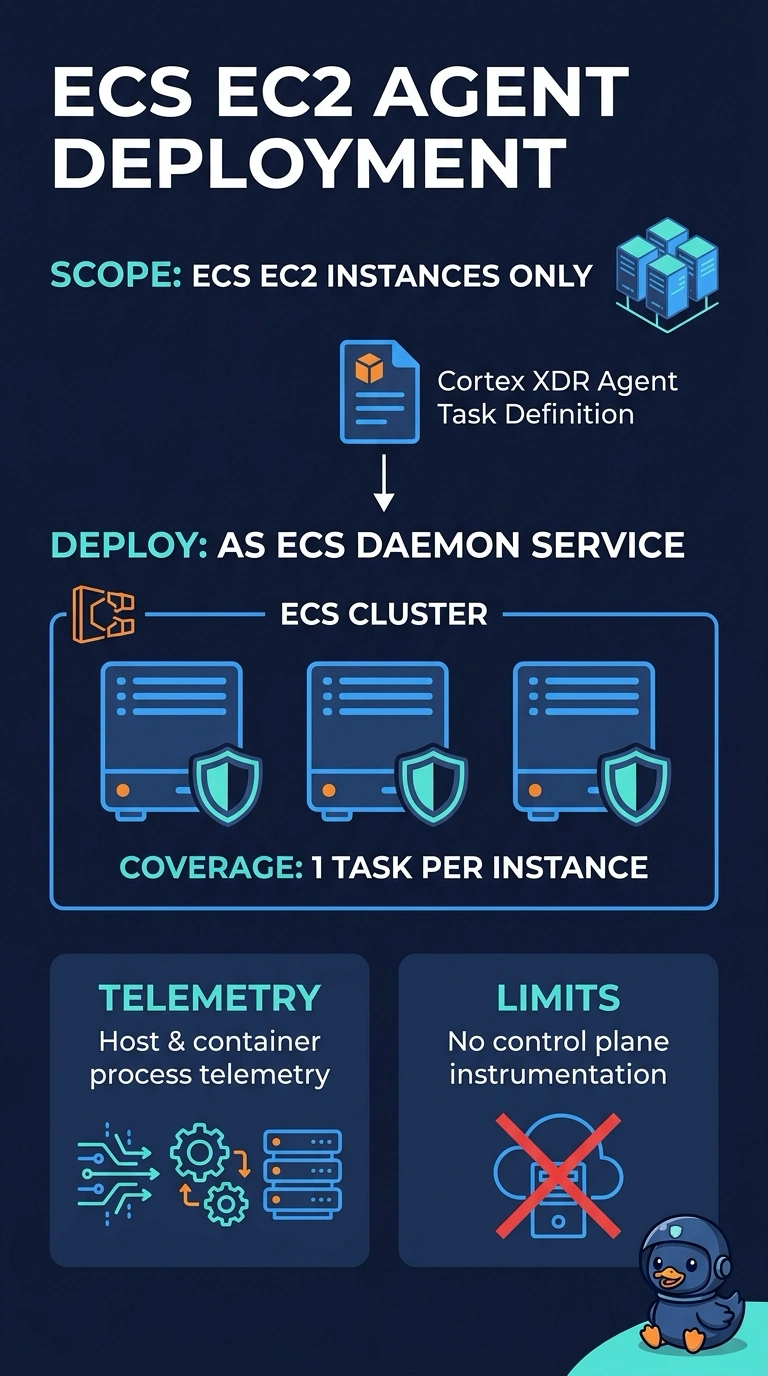
You want runtime telemetry from Amazon ECS on EC2, so you deploy the generated agent task definition as an ECS Daemon service. The supported ECS EC2 package runs one agent task per container instance and reports host/container process telemetry; it does not instrument the AWS-managed orchestration control plane. Other container services require their own supported deployment model.
Full Explanation
For Amazon ECS on EC2 container instances needing runtime telemetry, deploy the generated Cortex XDR agent task definition as an ECS Daemon service on the container instances. The supported ECS EC2 package runs one agent task per container instance and reports host/container process telemetry; it does not instrument the AWS-managed orchestration control plane. Other container services require their own supported deployment model. Hand-installing the agent on each container as if it were a long-lived virtual machine fails because containers are ephemeral and replaceable, so manual installs leave gaps and do not provide persistent per-instance coverage. A registry scan of the service image reports only image vulnerabilities and build-time findings with no runtime agent on the running service, so it cannot provide process telemetry. Installing the XDR agent on the Broker VM fails because the broker is a closed appliance that must not be modified, and an agent there does not instrument the ECS instances. Exam caveat: Daemon scheduling maintains one agent task on each active container instance. Practical check: confirm the Daemon service is steady-state on all instances, generate a test process in the service, and verify that it appears in runtime telemetry.