
A freight railroad needs to know which processes start on production virtual machines during a shift. Agentless disk scan is already running on those volumes. What should the platform team add so Cortex Cloud sees the live processes?
Select an answer to reveal the explanation.
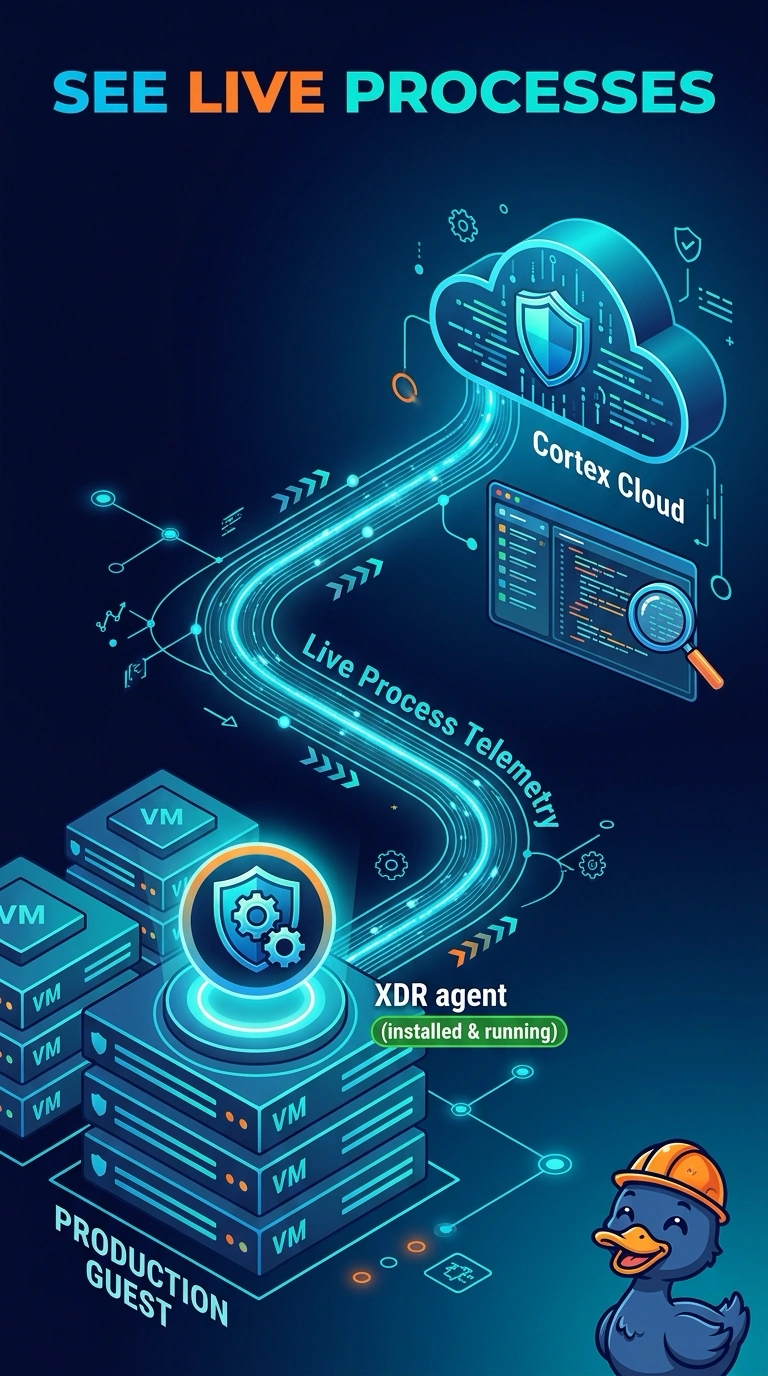
Short Explanation
Think of agentless disk scanning as reading a parked truck’s cargo list, not watching the driver shift gears. To see live process activity, you need the XDR agent installed and running on each production guest. Scanning the same volumes more often still cannot reveal a process that exists only in memory.
Full Explanation
The XDR agent installed and running on each production guest is the runtime sensor: it reports process activity while the virtual machine runs, which is the live telemetry the shift lead needs. Agentless disk scans inspect image or volume contents for findings such as misconfiguration, malware, or secrets; increasing their frequency still examines disk rather than a process that starts and exits during the shift. A Broker VM that forwards files but does not sit on the guest can bridge a closed network for routing, log collection, or file forwarding, but it is not the guest’s process sensor. Registry credentials used only for an offline image scan let a scanner read image layers in a registry; they provide an image-source integration, not live process telemetry from a running guest. Exam caveat: verify the effective prevention policy and agent health as well as telemetry. Agents receive default malware profiles, so a separate custom endpoint group or profile is not a universal prerequisite for protection. Practical check: confirm that each production guest shows a recent heartbeat, then start a known test process and verify that it appears in the agent’s telemetry.