
An airline platform team wants runtime coverage of Kubernetes nodes and the workloads on them. Image registry scanning is already in place. What completes that runtime coverage?
Select an answer to reveal the explanation.
Short Explanation
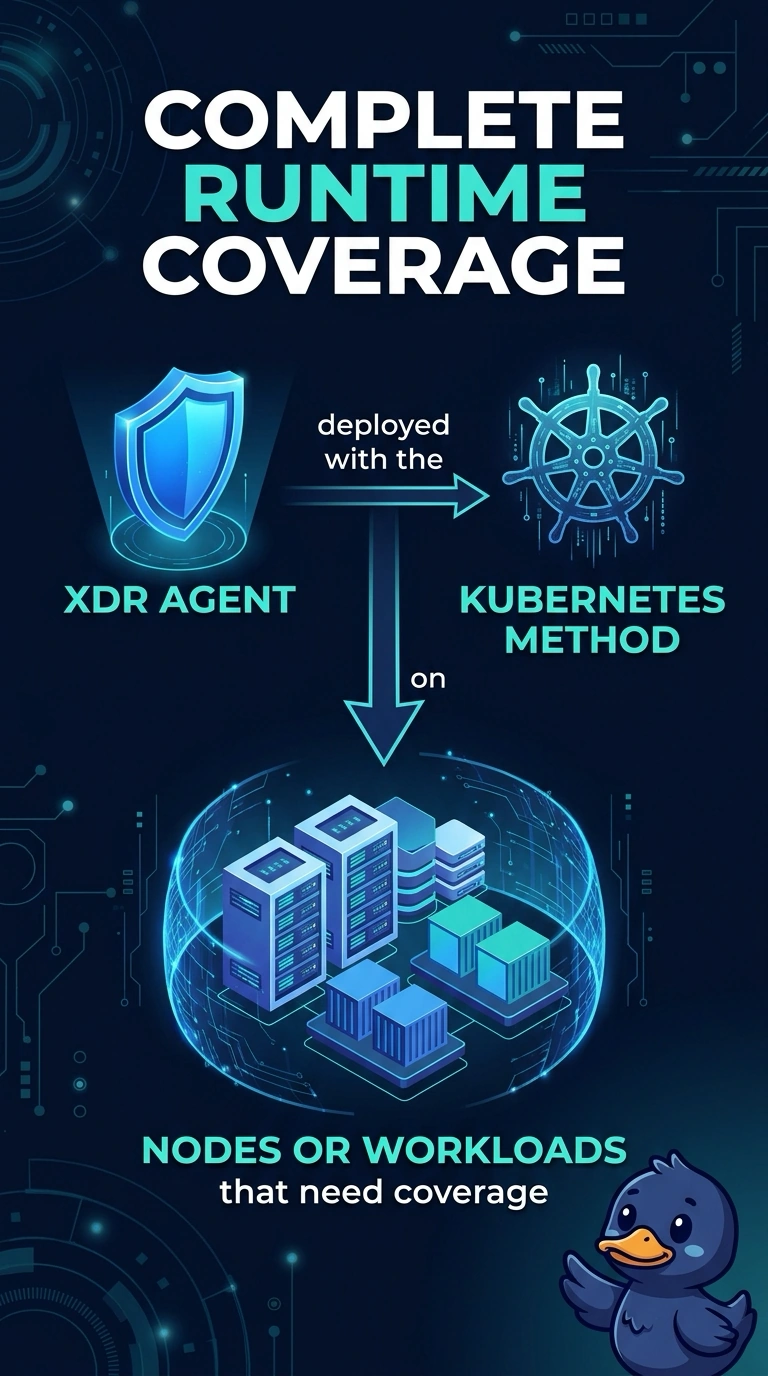
Think of a registry scan as the baggage tag, not the crew on the plane. You already know what is in the image, but runtime coverage of nodes and workloads still needs the XDR agent deployed the Kubernetes way. A second registry connection does not watch a process on the node.
Full Explanation
Agents cover Kubernetes nodes or workloads when that deployment model is in use. The airline already scans images in the registry, which tells you what is inside an image, not what a node or running workload does later. Deploying the XDR agent with the Kubernetes method provides runtime telemetry and prevention on the nodes or workloads that need coverage. A second registry connection to the same production repository only repeats image intake; it does not monitor runtime activity. An agentless disk scan limited to node images stored in the registry still inspects image contents and cannot see live process behavior on the cluster. A Broker VM registered as if it were the cluster runtime sensor is a mismatch: a Broker VM is a closed bridge for endpoint routing, logs, or file forwarding, not the cluster runtime sensor or a substitute for the agent. Exam caveat: the Kubernetes connector feeds resource posture for kind, metadata, and spec; it is not the agent. Operational check: confirm the agent is present on the intended nodes or workloads, verify heartbeats, and confirm that a test process on a covered workload appears in runtime telemetry.