
One tenant has clinic data stores that hold health records and a retail catalog account that holds none. The team wants PHI policy issues limited to the clinic. What should they do?
Select an answer to reveal the explanation.
Short Explanation
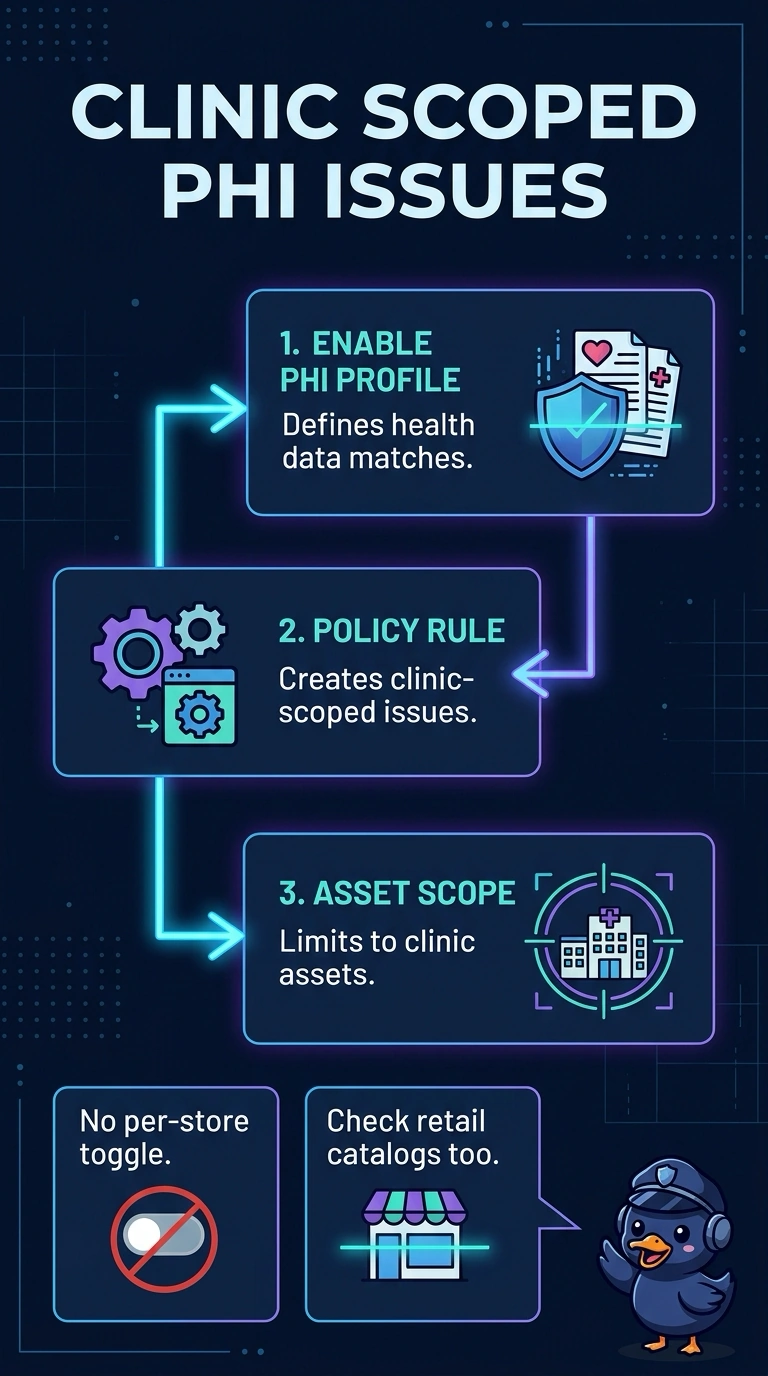
You get clinic-only issues when you keep PHI classification for detection and scope the PHI data-security policy to the clinic assets. The PHI profile defines matching data; the data-security rule/policy and asset scope control which clinic risks create the requested issues. Do not assume global profile enablement is a separate per-store switch, or infer a store contains no PHI merely because it is a retail catalog.
Full Explanation
The PHI profile defines matching data; the data-security rule/policy and asset scope control which clinic risks create the requested issues. Do not assume global profile enablement is a separate per-store switch, or infer a store contains no PHI merely because it is a retail catalog. Enabling PHI classification keeps detection for protected health information, while scoping the PHI data-security policy to clinic assets limits issues to the intended clinic scope and keeps the retail catalog outside that health scope. Filing internal hostnames as PCI mislabels infrastructure identifiers as cardholder data. PCI patterns target card numbers and related cardholder data, not hostnames, so that action cannot produce valid health findings and leaves classification incorrect. Turning OCR off tenant-wide is a global control for text inside images. It suppresses image text classification for every workload, so it cannot selectively keep PHI on clinic stores while handling retail image text differently. Enabling every shipped profile on both scopes over-collects. Developer Secrets, Financial, PCI, PHI, PII, and Sensitive together classify far more than health data and pull the retail catalog into profiles it does not need for this request.