
A data owner wants internal IP addresses and internal CIDR ranges classified. Those addresses are not card data, health data, personal identifiers, financial records, or developer tokens. Which profile fits these addresses?
Select an answer to reveal the explanation.
Short Explanation
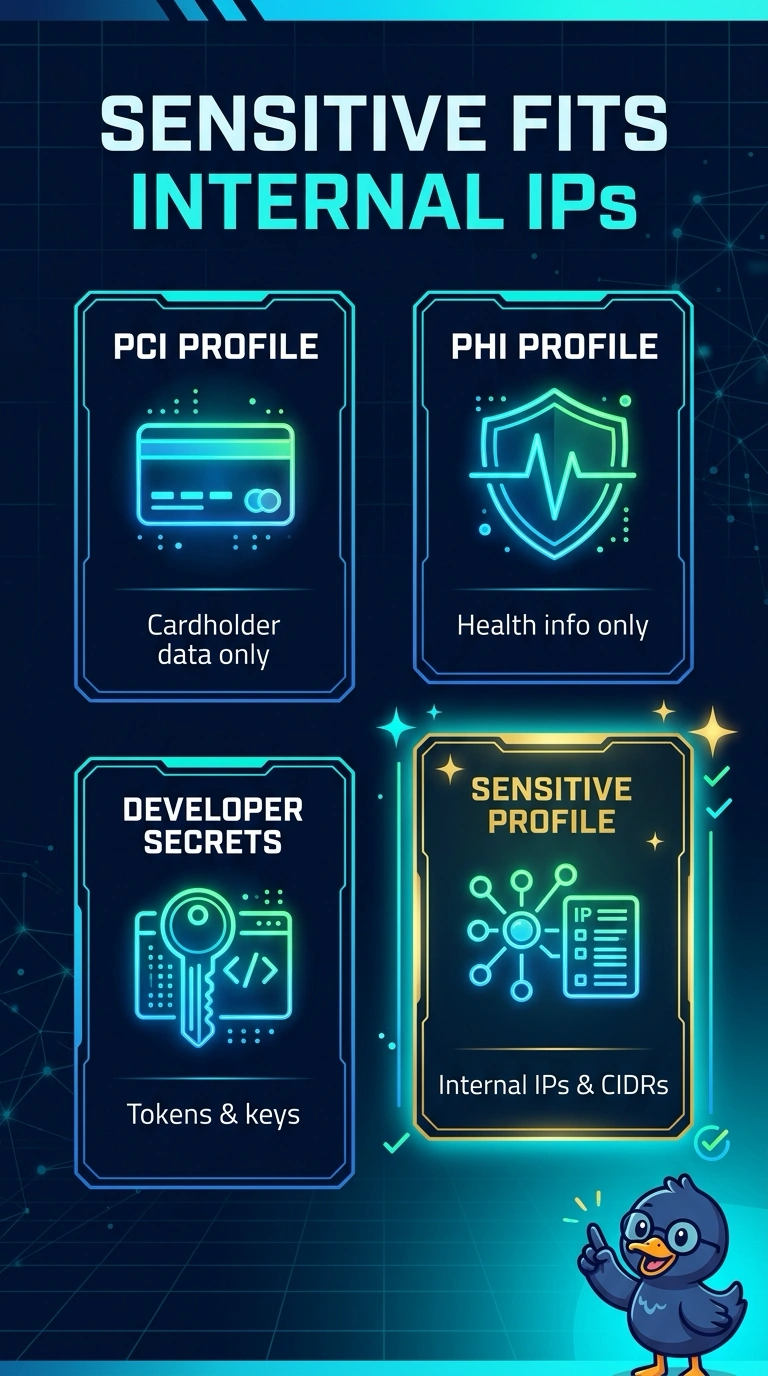
You keep scope clean by using Sensitive for internal IP addresses and internal CIDR ranges that are not card data, health data, personal identifiers, financial records, or developer tokens. PCI would misclassify them as cardholder data, while a clinic tag or an API-token profile does not change what an IP address is.
Full Explanation
The Sensitive profile fits internal IP addresses and internal CIDR ranges when they are not card data, health data, personal identifiers, financial records, or developer tokens. It includes documented patterns such as internal IPs/CIDRs; a confidential arbitrary project name is not automatically a shipped classifier just because the other listed profiles do not fit. The PCI profile is for cardholder data, so filing internal IP addresses and CIDR ranges as PCI misstates the data and pollutes cardholder scope. The PHI profile is for health information. A clinic tag on an account does not turn an internal IP address into health data, and the tag is not a reason to enable PHI for that string. The Developer Secrets profile is for tokens and keys in data stores. An internal IP address is not an API token or a cloud key, so that profile describes the wrong object. Exam caveat: Sensitive does not replace a specific profile when a value really matches that profile; use the specific profile for the data it is designed to classify. Practical check: classify one known internal IP address under Sensitive, then confirm it does not appear as a PCI card pattern or a Developer Secrets token.