
A pilot team disables the custom hardening standard it wrote for one account. Reviewers ask whether the out-of-the-box PCI standard was disabled along with it. What remains true?
Select an answer to reveal the explanation.
Short Explanation
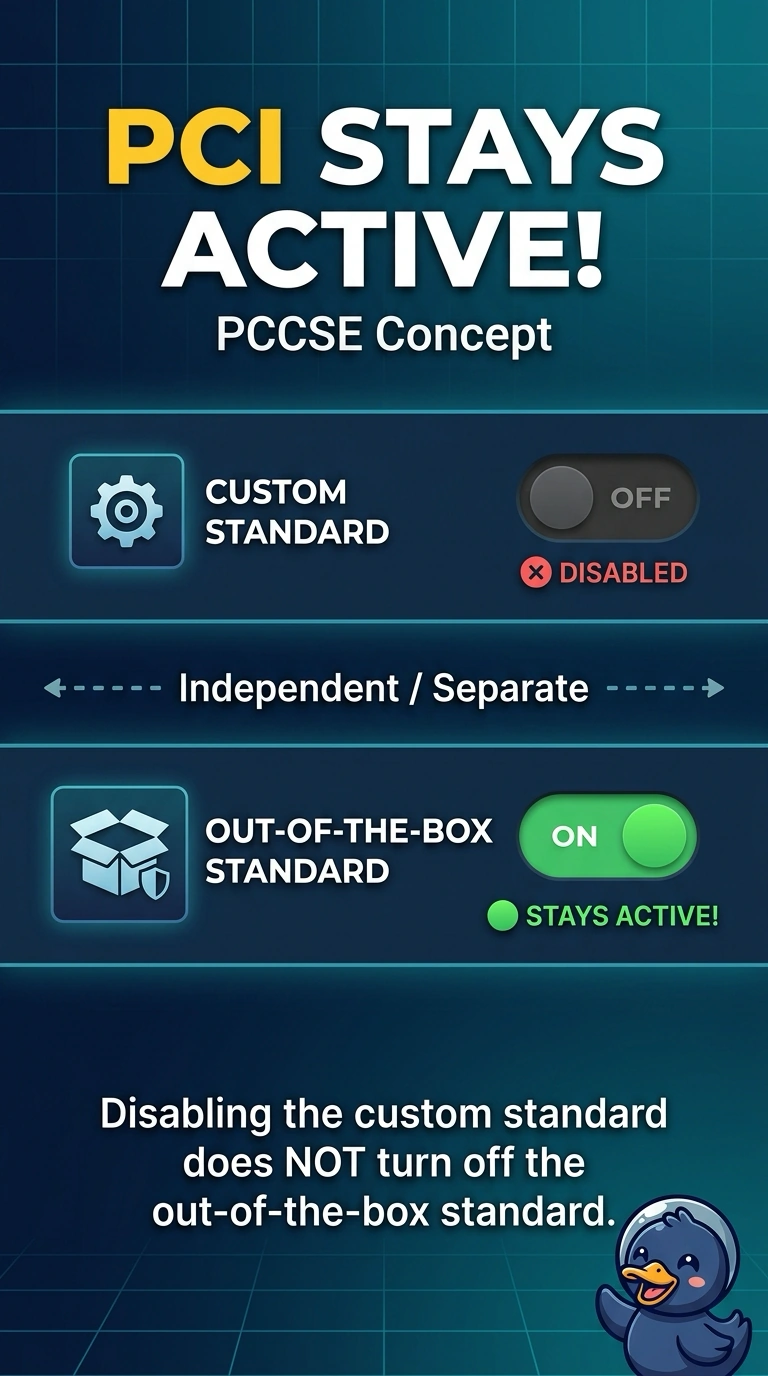
Turning off a house rule you wrote on a sticky note does not repeal the city code. You disabled a custom standard, and the out-of-the-box PCI standard stays active on its own. The trap is assuming only one standard can live in the tenant, so the pilot must have replaced PCI.
Full Explanation
Out-of-the-box standards and custom standards are separate assessments. Both can be active. Disabling the pilot's custom hardening standard stops that custom standard. It does not disable PCI. PCI is not the custom standard the pilot wrote, so disabling the pilot does not turn PCI off. A tenant is not limited to a single active standard, and creating a custom standard does not replace PCI. Results are not one shared cache tied to dashboard widgets. A widget is not the assessment record, and pinning or unpinning a widget does not clear PCI when a custom standard is disabled. Viewing or hiding a widget does not enable or disable a standard. PCI keeps scoring the assets in its own scope after the pilot standard is gone. Exam caveat: compliance results still follow asset scope, so a reviewer whose groups exclude cardholder assets can see an empty PCI tile even while the standard remains enabled. Operational check: with the custom standard disabled, open the PCI assessment as a user scoped to the cardholder assets and confirm PCI results are still produced.