
A retailer passed its PCI assessment last quarter. Three AWS accounts onboarded this month sit outside that assessment's asset groups. An auditor asks whether the old pass covers those new accounts. What should the engineer do?
Select an answer to reveal the explanation.
Short Explanation
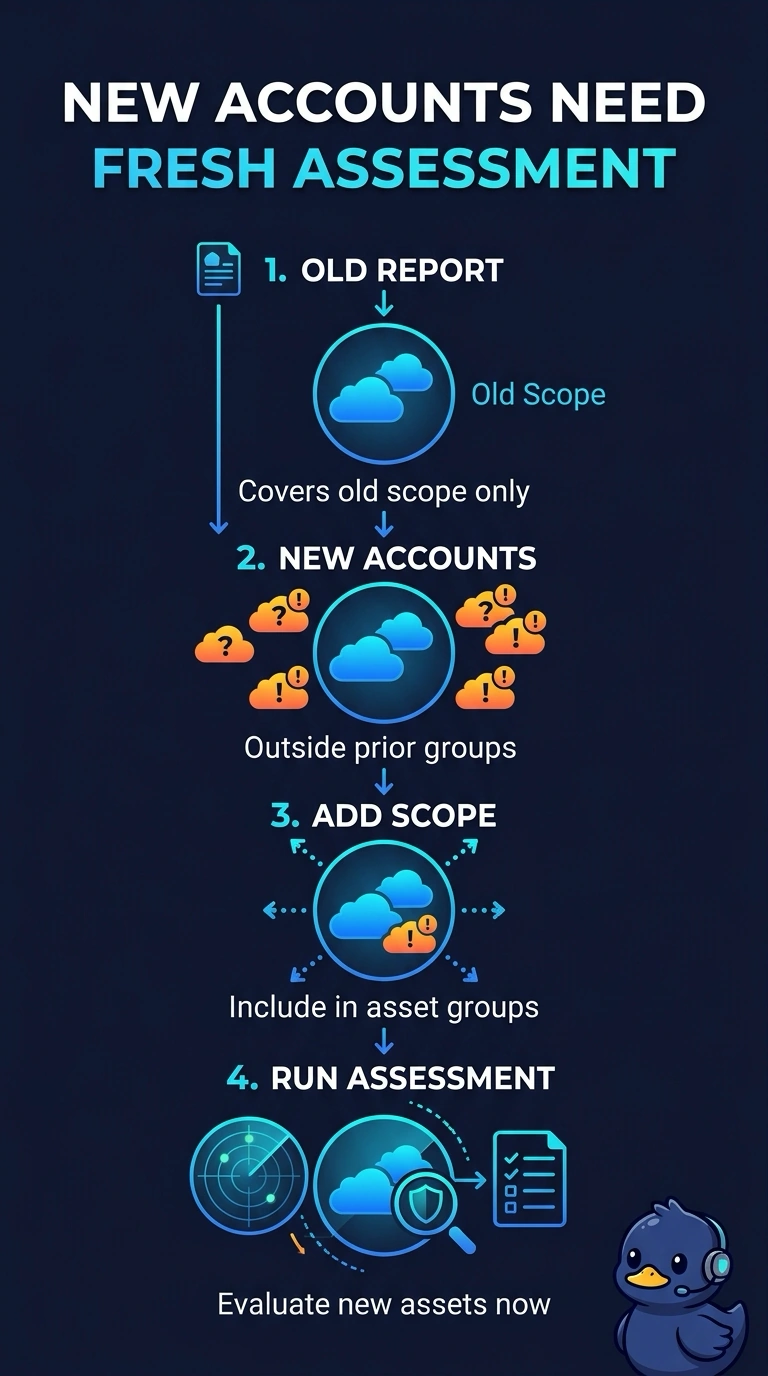
Picture last quarter's passing grade pinned to a classroom that has since added three new students. You cannot hand the old report to accounts that were never in the assessment's asset groups. The trap is treating a mapping or a copied standard as if the new accounts had already been assessed.
Full Explanation
A compliance assessment scores the assets in its scope at the time it runs. Three new AWS accounts sit outside that scope, so last quarter's pass says nothing about them. Both the correct scope and an assessment run that evaluates the new assets are required; adding assets to scope does not retroactively extend last quarter report. Including the new accounts in the assessment asset scope and running a new assessment covering them actually evaluates their configuration against PCI requirements. Attaching the old report to the new accounts does not evaluate their configuration. The file is evidence for the previous scope only. Mapping a passing control to a custom workload rule links a check to a control. It does not execute an assessment of the new accounts or convert them into a pass. Disabling PCI and copying its controls into a custom standard creates a different standard. Marking the new accounts passed from the old report skips the assessment entirely. Exam caveat: compliance results follow asset scope, so an admin who can see the new accounts may still be looking at a report whose groups exclude them. Operational check: open the assessment's asset groups, verify the three account identifiers are members, then run the evaluation that includes them because scope alone does not extend the prior pass.