
The same CVE should open a low issue on development servers and a critical issue on production servers at a transit agency. How should they set that difference?
Select an answer to reveal the explanation.
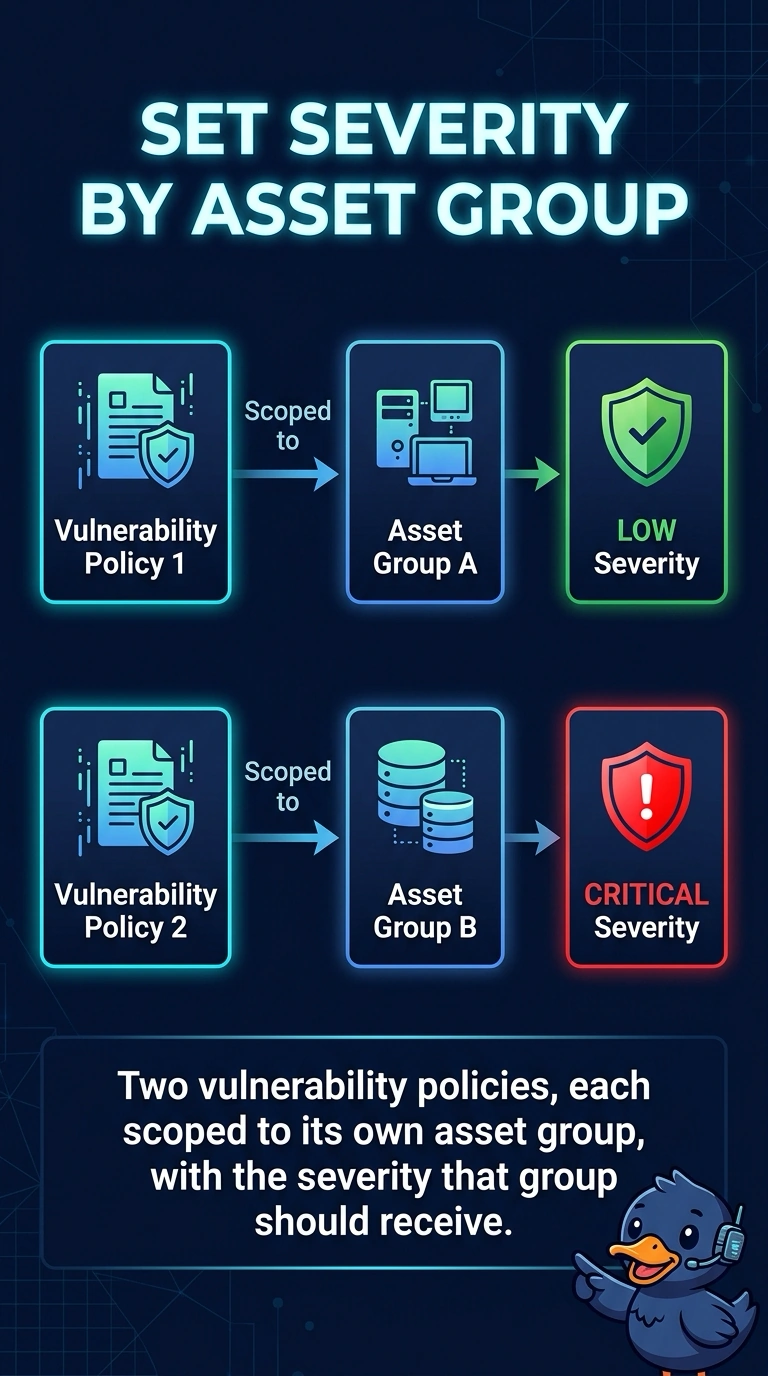
Short Explanation
You can keep one scanner and give development and production different outcomes with vulnerability policies scoped to their asset groups. A global endpoint exception would loosen prevention across both groups, while a PCI classification profile does not set CVE severity.
Full Explanation
Vulnerability policies match from top to bottom, and each policy can be scoped to an asset group. Issue severity is a policy action, not something set by compiling a second scanner. Use one vulnerability policy scoped to development to open a low issue and another scoped to production to open a critical issue; order them so each asset matches the policy for its group. Two copies of the agentless scanner binary do not change issue severity: agentless disk scanning is a workload-scanner function, while this CVE outcome is a vulnerability-policy decision. A global endpoint exception is a broad prevention carve-out, not a way to assign different issue severities to development and production; it would weaken prevention across both groups. A PCI classification profile identifies cardholder data, but enabling it on production and disabling it on development does not set CVE issue severity for those servers. Exam caveat: because policies match top to bottom, verify that the group scopes and ordering let each asset reach its intended policy. Practical check: test one development asset and one production asset with the same CVE, then confirm that their issues are low and critical, respectively, under the matching groups.