
A rental fleet must not open vulnerability issues for leased lab assets, while production findings still create issues. How should the ignore be placed?
Select an answer to reveal the explanation.
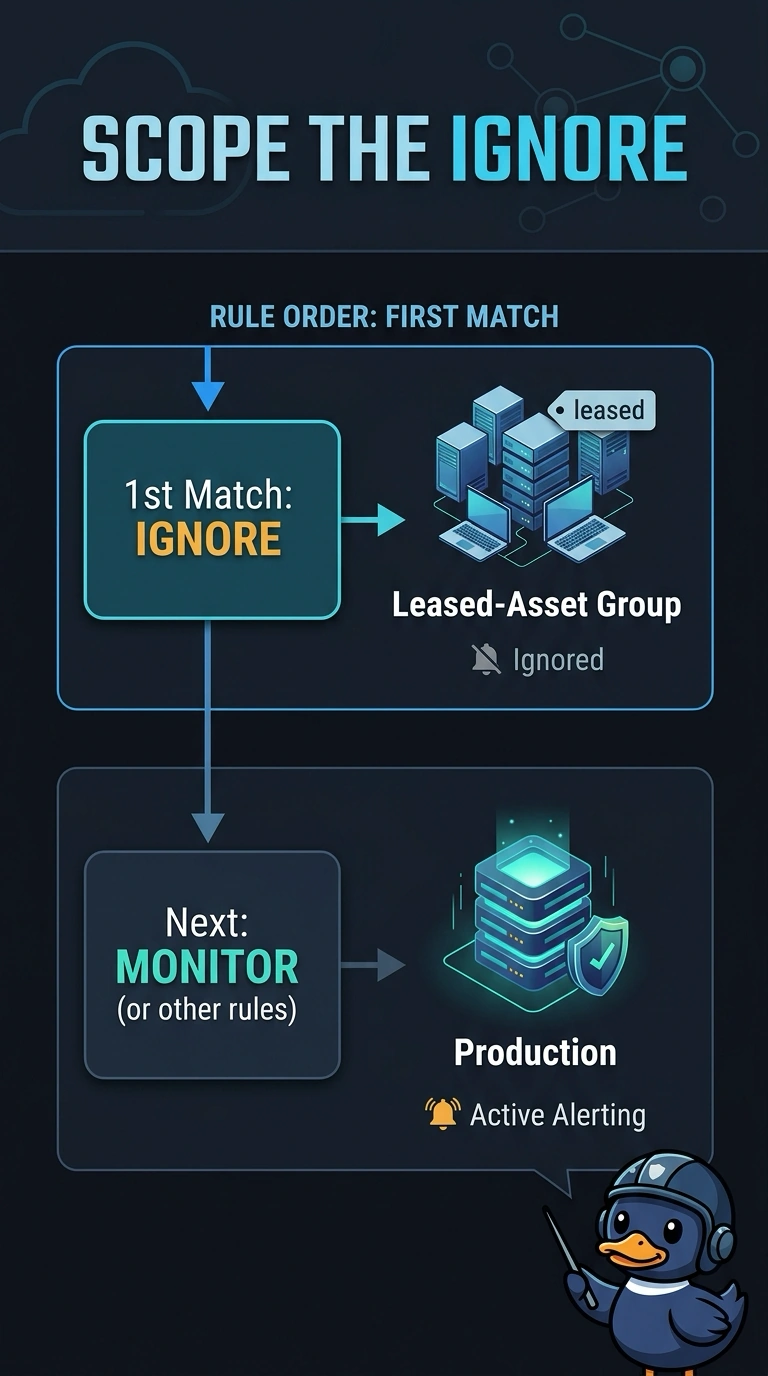
Short Explanation
Think of an ignore as a bypass lane that should exist only for the leased cars. You want no issue on that lab group and normal issues on production, so the ignore has to be scoped to the leased assets and sit where first match hits them alone. A tenant-wide ignore above production would erase the issues you still want.
Full Explanation
Vulnerability policies use first match from the top, and ignore means no issue is created. The leased lab assets need an ignore scoped to that asset group, ordered so those assets match the ignore and production assets do not. Production findings then continue to a policy that creates issues. A tenant-wide ignore placed above every production policy matches production first as well, so first match suppresses the issues the fleet still wants. An admission block is prevention for a new Kubernetes deployment when the agent and the admission controller are in place. It does not stop issue creation for leased virtual machines, and it is the opposite of an ignore. A static group cannot be an access scope. Scope-Based Access Control uses dynamic groups only, and an access-scope mistake does not implement a vulnerability ignore. Exam caveat: an ignore that is scoped correctly and still sits below a broader policy never runs for assets the higher policy already matched. Operational check: evaluate one leased asset and one production asset with the same vulnerability, and confirm only the production asset gets an issue.