
A pharmacy wants a critical issue for every CISA KEV vulnerability on production assets, including findings whose CVSS score is only moderate. Where should that rule live?
Select an answer to reveal the explanation.
Short Explanation
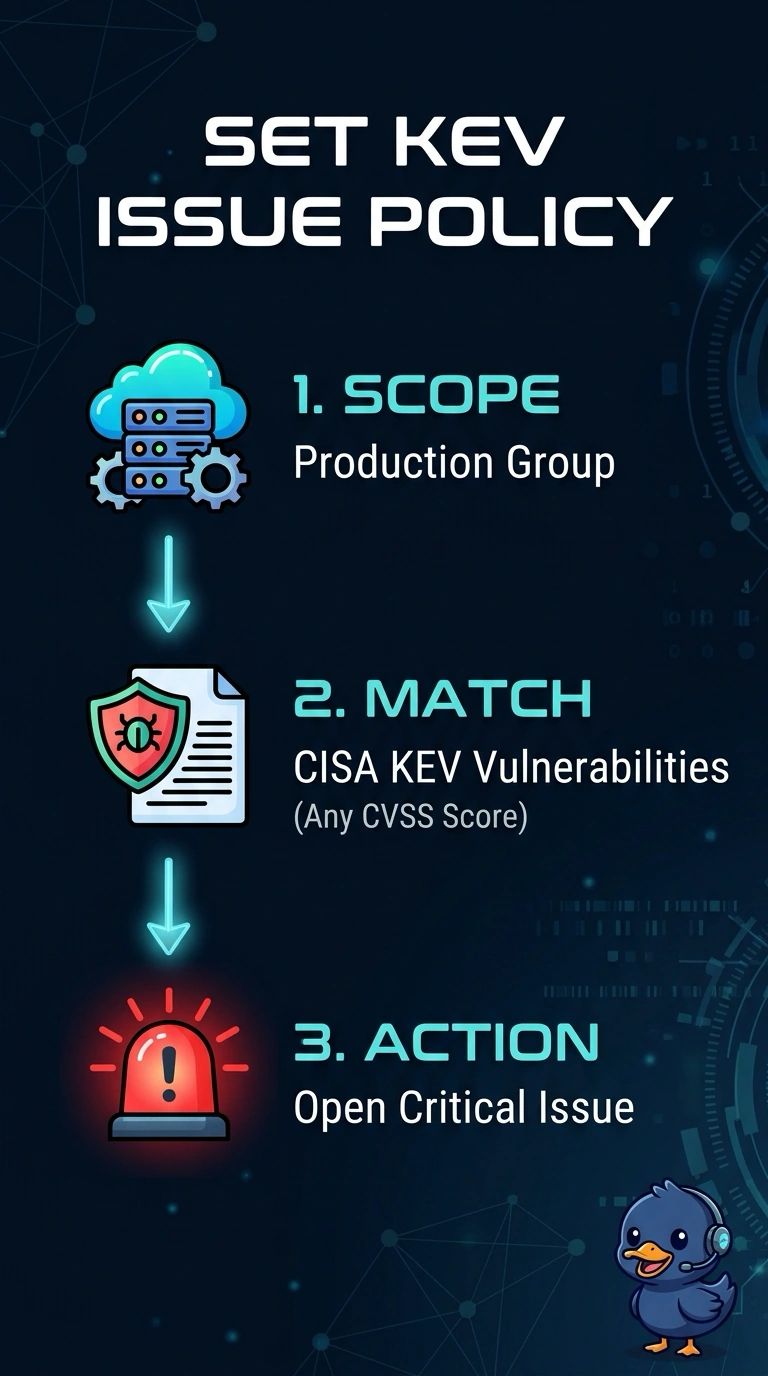
Think of KEV as a known-bad recall, separate from how flashy the score looks. You want a critical issue on production even when CVSS is moderate, and that belongs in a vulnerability policy scoped to the production group. A data profile classifies files and does not open vulnerability issues.
Full Explanation
Vulnerability policy actions include issue creation, and scope is an asset group. A critical issue for a CISA KEV vulnerability on a production group does not require a high CVSS score when the policy says so. The pharmacy's cutoff belongs in a vulnerability policy scoped to that production group. An agentless disk-scan rule is a Cloud Workload rule evaluated against an image. A deny-style Kubernetes rule is the wrong shape anyway, because connector rules use match in package panw.compliance, and neither scanner is where KEV issue severity is chosen. The PCI profile is a data-classification profile for cardholder patterns. Turning off image text recognition skips text inside images for classification. It does not create vulnerability issues. A global endpoint exception loosens prevention on every endpoint in scope. It does not open a critical issue, and it is wider than a production vulnerability policy. Exam caveat: first match still applies, so a broader ignore above this policy will swallow the KEV findings before the critical action runs. Operational check: place the KEV policy on the production group, put a moderate-CVSS KEV finding through it, and confirm the issue is critical only for that group.