
A dental group lists a broad ignore for all assets first and a critical-issue policy for production second. Production CISA KEV findings create no issues. Why?
Select an answer to reveal the explanation.
Short Explanation
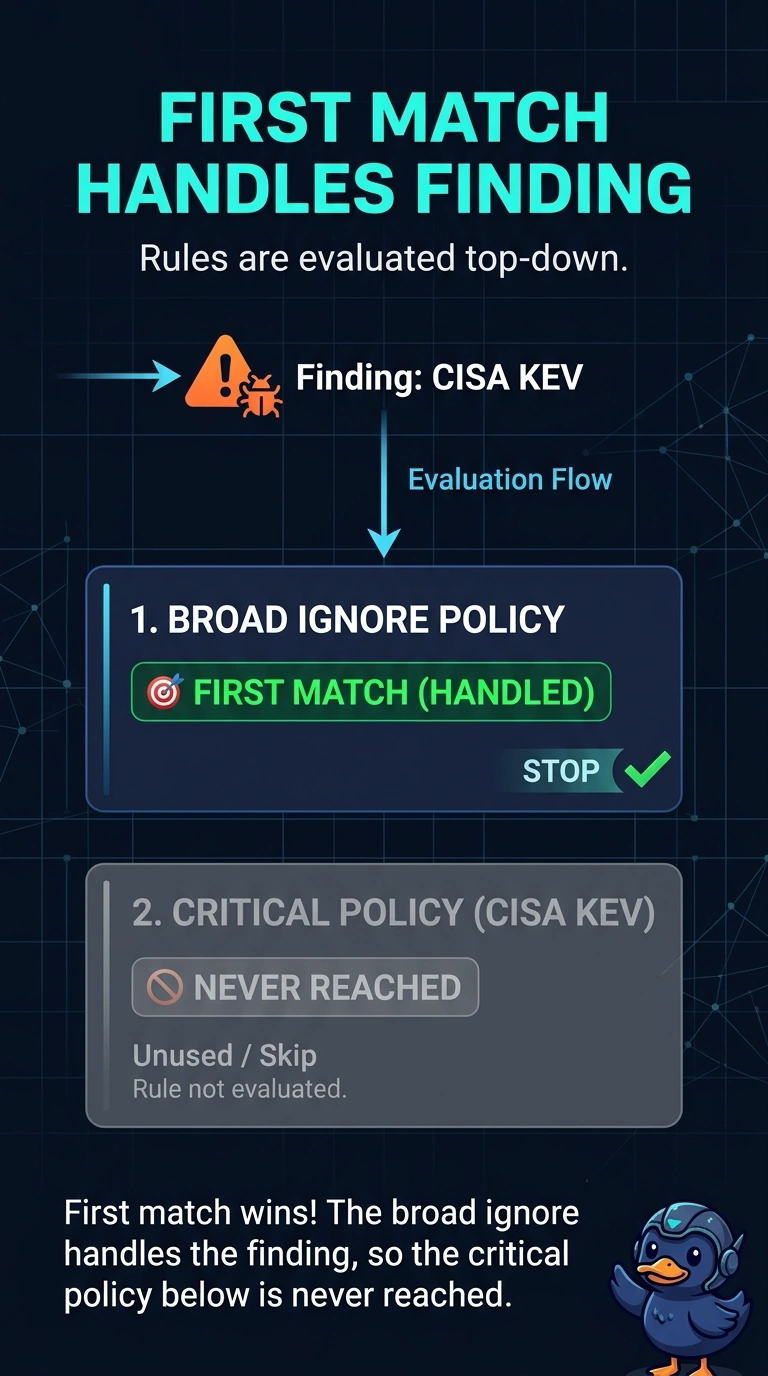
Think of the policy list as a stack of sieves where the first one that fits keeps the grain. You put a broad ignore above the production critical policy, so the ignore matches first and the critical rule never gets a turn. Reordering is the fix, and removing admission control would not create these issues.
Full Explanation
Vulnerability policies are evaluated top to bottom, and the first match wins for that finding. A broad ignore for all assets sits above the policy that would open a critical issue for production, so production CISA KEV findings match the ignore and never reach the critical policy. The action on that first match is ignore, which means no issue is created. Attaching one asset group to only a single vulnerability policy is not how scope works. The same group can be reused, and the failure here is order, not a one-group limit. A predefined EPSS policy does not delete custom policies below it. Lower policies still exist; they simply do not run once a higher policy has matched. Admission control is a prevention path for new Kubernetes deployments when the agent is present. It does not decide whether a vulnerability policy creates an issue, and removing it would not make the ignore stop matching. Exam caveat: first match is per finding, so a narrower production policy only works if it is placed where it is the first match for those assets. Operational check: read the policy order, confirm the ignore is first and scoped to all assets, move or narrow it so production KEV findings hit the critical policy first, and rescan one production asset.