
Leadership at an insurer wants the queue of chained cloud risk, such as a public bucket exposing usable credentials for an overprivileged role that can access a private sensitive store. Analysts are paging a flat list of low-severity configuration findings. Which rule family matches the request?
Select an answer to reveal the explanation.
Short Explanation
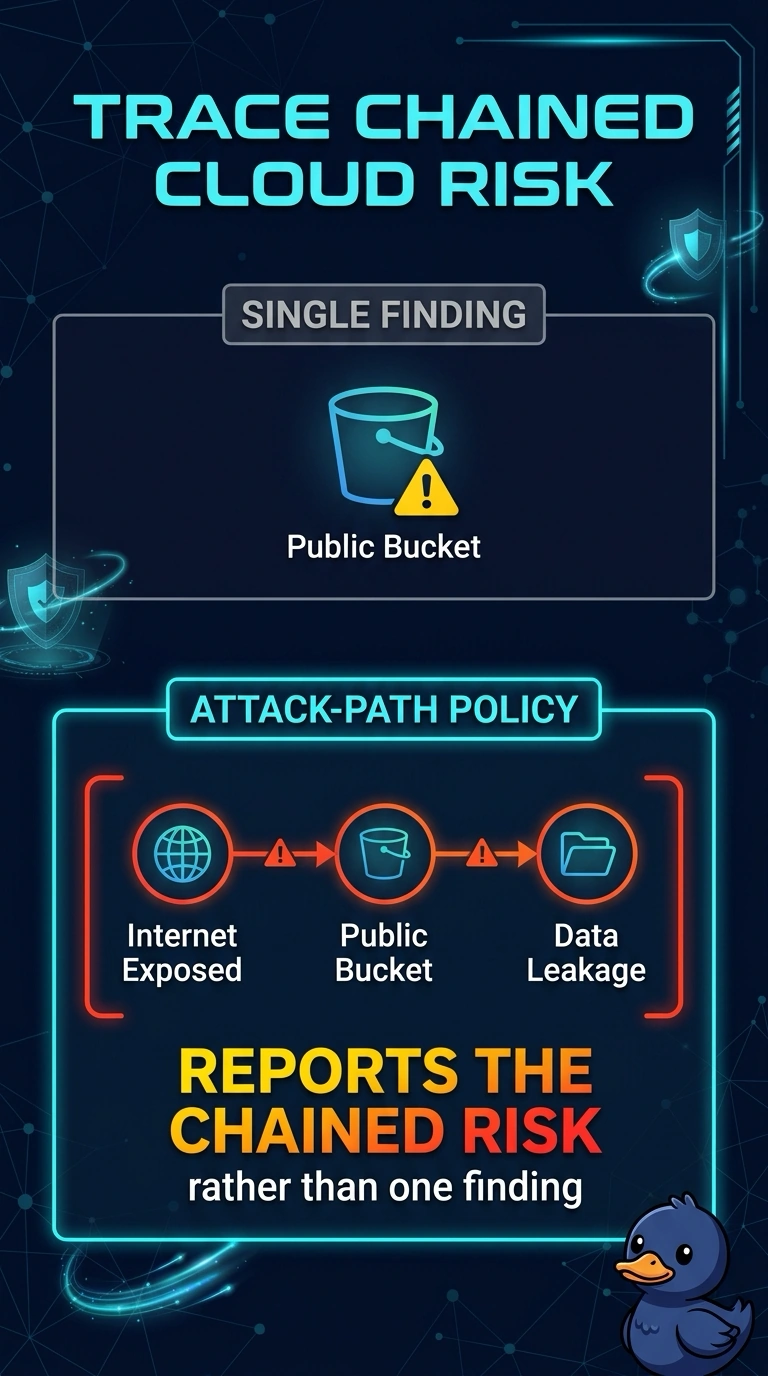
Think of a chain as the whole story and a single finding as one sentence pulled out of it. You were asked for the path such as a public bucket exposing usable credentials for an overprivileged role that can access a private sensitive store. A flat list of low configuration findings is the pile leadership is already tired of reading.
Full Explanation
An attack path is the chain, not any single misconfiguration. Leadership asked for chained risk, such as a public bucket exposing usable credentials for an overprivileged role that can access a private sensitive store, so the attack-path rule family is the queue that matches. A vulnerability policy ordered by high CVSS scores on packages is about vulnerable software and predefined CVSS, EPSS, or attack-surface handling. It does not assemble a storage-and-identity chain. A trusted-image workload rule allows a golden registry and flags other images. That is a workload outcome, not a cloud attack path. A flat export of every low-severity configuration finding, sorted by account and left unchained, is the queue the analysts already have. A public bucket alone can be a configuration or network-exposure finding, and the over-privileged role can be an identity finding, but neither list is the chain. Exam caveat: one critical configuration finding can still be urgent on its own. It just is not what this request for chained risk asked to review. Verify a traversable chain from entry point through the compromised identity to the target. Public storage plus a role with unrelated permission is only a combination of observations until an exploitable relationship is established.