
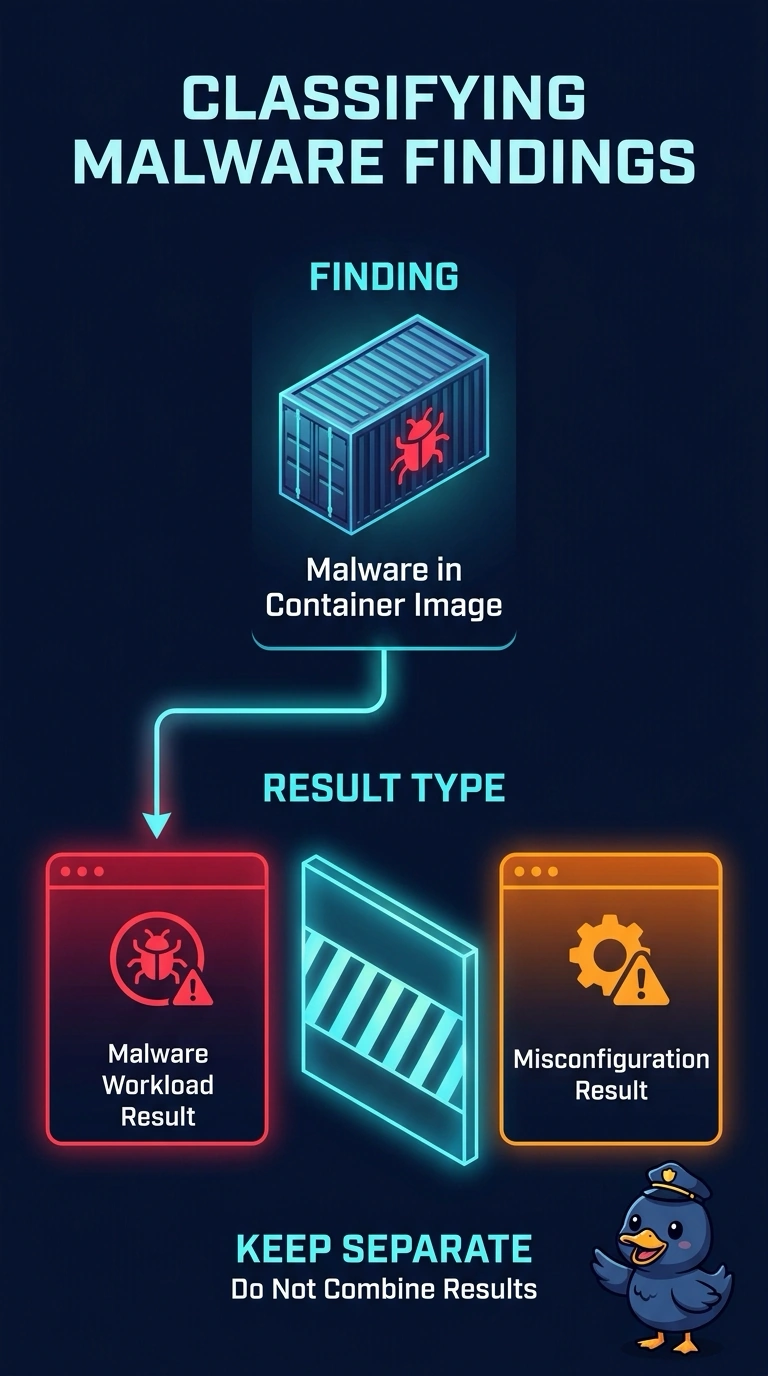
A workload scan reports malware inside a container image. A teammate files it as a Dockerfile misconfiguration and closes it with a style fix only. How should this result be classified?
Select an answer to reveal the explanation.
Short Explanation
Think of malware in the image as a spoiled ingredient and a Dockerfile style issue as messy handwriting on the recipe card. You do not fix a bad ingredient by neatening the card. Classify this as a malware workload result, not as a misconfiguration.
Full Explanation
Misconfiguration, malware, secrets, and trusted images are different workload outcomes. Malware inside a container image is the malware outcome. A Dockerfile style fix addresses how the image was written, which is a misconfiguration concern, and closing the malware result that way leaves the malicious content in the image. An identity finding is an over-privileged role or a similar identity problem. The role the image might assume in the cloud is a different rule family and does not reclassify bytes inside the image. An attack path is a chain of conditions, not a label you put on every malware hit. One malware result is not automatically a chain of configuration findings. Data classification looks for patterns such as card numbers, with profiles such as PCI or PHI, and it can keep masked samples. Malware is not stored as masked pattern text, and a classification profile does not replace the malware outcome. Exam caveat: a trusted-image rule can still restrict which registries are allowed, and that allow-list does not declare the malicious image clean. Operational check: keep the finding in the malware outcome, locate the image digest that contains it, and require a rebuild from a clean base before the result is closed.